Thursday, 08 October 2026

DELI SERDANG | INDATANEWS.COM - Waste is no longer viewed as a problem that must be disposed of as quickly as possible in Environment VII, Galang Kota Urban Village, Galang District, Deli Serdang Regency. Instead, residents and local authorities see it as a raw material that can drive economic activities, ranging from fish farming and poultry raising to the development of products by micro, small and medium enterprises (UMKM).
The idea was among the potentials that received particular attention from the Field Verification and Validation Team of the "Kampung Kreatif Sumut Berkah" program during its visit to the area on Tuesday, October 6, 2026. The visit was accompanied by Assistant for Government Affairs and Public Welfare at the Deli Serdang Regency Secretariat, Zainal Abidin Hutagalung.
The team examined not only the physical condition of the area but also its economic potential and the community's readiness to develop an entrepreneurial-oriented neighborhood. The assessment identified several potentials that could be connected into an integrated economic cycle, including a Reduce, Reuse, Recycle (TPS 3R) waste processing facility, catfish farming, laying-hen farming, tofu production, UMKM, and culinary businesses.
Under this concept, waste management does not stand alone. Organic waste can be processed into feed for maggot larvae, which can then support fish farming and poultry raising. The resulting products can subsequently enter the value chain of UMKM and culinary businesses.
In this way, waste that was previously considered worthless can be reintegrated into the community's economic activities.
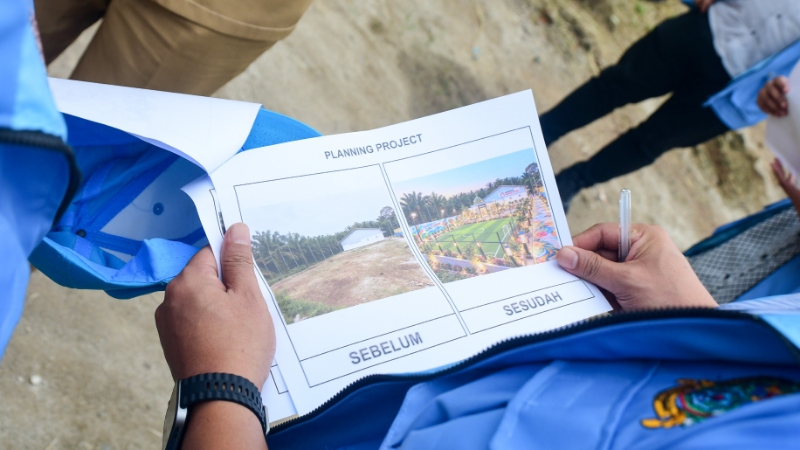
The head of Galang Kota Urban Village, Gusri Salwa Gea, explained that the area designated for the development of Kampung Kreatif would cover approximately 300 to 500 meters. The urban village administration has prepared various development concepts so that the area will not only look more orderly but can also become a space for community-based economic activities.
The planned development includes paving or concreting the access road, constructing an entrance gate, installing solar-powered lights, creating murals, and providing space for UMKM and culinary businesses.
The development of the area, however, is not limited to physical construction. The TPS 3R is an important component of the concept because waste management is designed to produce materials that can be reused.
Organic waste will be processed into feed for maggot larvae. These larvae can then be used to support fish farming and livestock activities. Meanwhile, inorganic waste, particularly plastic, can be shredded and used as raw material for products with economic value.
The concept also gives residents opportunities to develop businesses based on raw materials available in their own surroundings.
"Our hope is that the waste that comes in will no longer come out as waste, but can instead be processed into items that have use and market value," said Gusri Salwa Gea.
This management model can create a link between the environmental and economic sectors. Waste becomes raw material, the processed output supports livestock and fish farming, while the final products can be marketed through UMKM and culinary businesses.
As a result, environmental management can not only contribute to a cleaner neighborhood but also create new sources of income for residents.
In addition to waste management, Galang Kota has other economic potentials that can strengthen the local ecosystem. One of them is tofu production, which is expected to be developed into a leading local product as well as a typical souvenir from Galang.
The development of this product can provide residents with opportunities to increase the added value of their production. Tofu would not merely be sold as an everyday food product but could be further developed through packaging, product innovation and marketing as part of the area's identity.
This potential can be developed alongside catfish farming, laying-hen farming, UMKM and culinary businesses. When these sectors are organized into a shared value chain, they can support one another and create more diverse economic activities.
This concept is among the key points being examined through the verification of the "Kampung Kreatif Sumut Berkah" program. The team wants to ensure that the program does not merely produce new facilities but actually creates economic activities that can continue operating after construction work has been completed.
The representative of the Field Verification and Validation Team, Nusrat Andrus Hadir Syabri, reminded residents that before the program begins, the government and community must ensure the legality of the land, including the relevant ownership and use rights. According to him, legal certainty regarding the land is important to prevent legal problems that could affect the sustainability of the program.
At the same time, residents must prepare people responsible for each facility and planned business unit. Clear responsibilities are an important factor in ensuring that the facilities do not lose their functions once construction is completed.
"The most important thing is not only the output in the form of construction work, but also the outcome that emerges from it. It must be clear who will be responsible for livestock, gardens, fish ponds, UMKM and other facilities," he said.
The message underscores that the success of Kampung Kreatif cannot be measured solely by the construction of roads, entrance gates, lighting, murals or other facilities. More importantly, the development must generate productive activities and contribute to improving the welfare of the community.

The team encouraged residents to form groups responsible for managing the various facilities and business activities. These groups will eventually organize the use of the facilities, ensure business sustainability and make sure that the benefits of the development continue to reach local residents.
Such a model can also strengthen community participation in the development of the area. Residents would not merely become beneficiaries but would serve as the main actors driving economic activities.
Galang Kota has favorable conditions for developing this concept. In addition to its diverse economic potential, the area has relatively good connectivity to the center of Deli Serdang Regency and Kualanamu Airport.
This connectivity could be an advantage when residents begin developing local products and seeking access to broader markets. Processed tofu products, fish-farming and livestock products, food products and UMKM goods can be marketed not only to local residents but also to consumers outside the area.
If all these potentials can be properly connected, Galang Kota could develop not only a better-designed neighborhood but also a community-based economic ecosystem.
Waste can become raw material. Maggot larvae can support fish farming and livestock activities. Products from livestock and fish farming can enter the processing and culinary sectors. UMKM can then serve as the spearhead for marketing the products.
This value chain opens opportunities to increase residents' incomes while creating new jobs. At the same time, the TPS 3R can help reduce the waste problem in the residential area.
The "Kampung Kreatif Sumut Berkah" program therefore provides an opportunity to change how residents view local potential. An area previously seen simply as a residential neighborhood can develop into a center of economic activity that makes use of resources available in its immediate surroundings.
The challenge is no longer merely to build facilities, but to ensure who will manage them, how the businesses will operate, where the products will be marketed and how the economic benefits will return to the community.
If these aspects can be secured from the outset, Galang Kota has the opportunity to become an example of a Kampung Kreatif that is not solely based on physical development but can transform environmental problems into economic opportunities for the community. (IDNC)
REPORTER:Edi Saputra | EDITOR: Fik Sagala



 /home/u7391150/public_html/indatanews.com/theme/function.php on line 28