Sunday, 04 October 2026
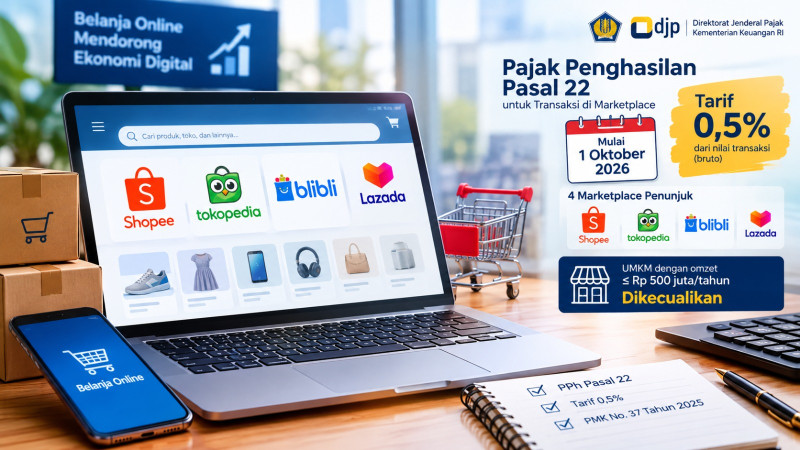
JAKARTA | INDATANEWS.COM - Indonesia's Directorate General of Taxes (Direktorat Jenderal Pajak – DJP) will begin collecting Article 22 Income Tax (PPh Pasal 22) on income earned by domestic merchants conducting transactions through online marketplaces on October 1, 2026. The policy applies to four Electronic Trading System (Perdagangan Melalui Sistem Elektronik – PMSE) operators appointed by the government as tax collection agents under a decision issued by the Director General of Taxes on September 24, 2026.
The four marketplaces are PT Shopee International Indonesia, PT Global Digital Niaga Tbk, PT Tokopedia, and PT Ecart Webportal Indonesia. Through this policy, the government is establishing a mandatory mechanism for collecting income tax on earnings generated by domestic merchants conducting business through electronic trading platforms.
Initially, the government had set a transition period until October 31, 2026, before implementing the collection of Article 22 Income Tax through marketplaces. In determining this period, the government considered various factors, including the economic conditions of the public and the technical and administrative readiness of platform operators to implement the policy.
However, following an assessment of the system and administrative readiness of the affected marketplaces, the government decided to bring forward the implementation date to October 1, 2026. Consequently, the policy will take effect earlier than originally scheduled.
Director General of Taxes Bimo Wijayanto explained that the revised implementation schedule followed an assessment by the relevant government authorities of the requirements for enforcing the regulation. Although the implementation date has changed, the substance of the provisions under Minister of Finance Regulation (Peraturan Menteri Keuangan – PMK) No. 37 of 2025 remains unchanged.
"The government previously granted a transition period after taking various considerations into account. However, following an evaluation of the implementation results and the readiness of the relevant parties, it was decided that the collection of Article 22 Income Tax through marketplaces would begin on October 1, 2026. We will continue to ensure that the implementation proceeds smoothly while providing merchants with legal certainty and convenience," Bimo said.
Under Minister of Finance Regulation PMK No. 37 of 2025, the government appoints marketplace operators as designated third parties responsible for collecting Article 22 Income Tax on income earned by domestic merchants. As a result, platform operators will be responsible for collecting the tax when merchants complete transactions through their respective digital platforms.
The applicable tax rate is 0.5 percent of gross sales or the total transaction value generated by merchants. The calculation excludes Value Added Tax (Pajak Pertambahan Nilai – PPN) and Luxury Goods Sales Tax (Pajak Penjualan atas Barang Mewah – PPnBM).
Marketplaces will collect the tax as part of electronic transactions conducted through their platforms. Through this mechanism, the government aims to simplify tax compliance for merchants, as platform operators will withhold the applicable tax directly during the transaction process.
The appointment of the four companies as Article 22 Income Tax collection agents forms part of the government's efforts to regulate taxation in digital commerce. At the same time, the government expects this mechanism to support more orderly tax administration and provide greater legal certainty for merchants operating through marketplaces.
Bimo emphasized that the regulation does not introduce a new type of tax for merchants. Instead, it focuses solely on reorganizing the collection mechanism for existing tax obligations.
"This regulation concerns the collection mechanism for tax obligations that already exist. By involving marketplaces, we hope to make tax compliance simpler and more orderly while providing businesses with greater legal certainty," Bimo said.
In implementing the policy, the government continues to provide relief for smaller businesses. This provision particularly applies to individual taxpayers whose annual turnover does not exceed IDR 500 million within a tax year.
The Directorate General of Taxes clarified that merchants falling within this turnover threshold are exempt from Article 22 Income Tax collection by marketplaces, provided they have submitted the required declaration in accordance with applicable regulations.
This provision allows small businesses to continue conducting commercial activities through digital platforms without having the relevant income tax withheld by marketplaces, provided that all prescribed administrative requirements have been fulfilled.
For this reason, the Directorate General of Taxes has urged merchants to carefully review their tax information and required supporting documents. The relevant documents can be submitted through the procedures provided by their respective marketplaces.
The tax authority also explained that Article 22 Income Tax already withheld by marketplaces can be credited against a merchant's tax liability in the current tax year or taken into account when settling Final Income Tax (PPh Final). The application of this procedure remains subject to applicable laws and tax regulations.
Therefore, merchants should understand their respective tax status and the administrative requirements applicable to their business activities. Complete documentation is essential to ensure that marketplaces collect taxes correctly and grant eligible taxpayers the exemptions provided under the regulations.
To ensure smooth implementation of the policy, the Directorate General of Taxes is continuing its coordination with all PMSE operators appointed by the government. The authority is also conducting information sessions and providing guidance to merchants and other stakeholders to help them understand the provisions governing Article 22 Income Tax collection.
Bimo reiterated that the regulation does not introduce a new type of tax. Together with marketplace operators, the government is working to simplify the collection process and provide merchants with greater certainty when fulfilling their tax obligations.
"The public should understand that this mechanism does not create a new tax. The Directorate General of Taxes is working together with marketplace operators to make tax collection simple and orderly while providing merchants with legal certainty," Bimo explained.
Furthermore, the Directorate General of Taxes has urged merchants to verify the accuracy and completeness of the tax information registered in their respective marketplace accounts. This step is important to ensure that all submitted information and documents comply with applicable tax regulations.
"We urge merchants not to worry and to first ensure that their tax information and supporting documents comply with the applicable regulations," Bimo said in closing.
The Directorate General of Taxes expects that continued cooperation with marketplace operators and the regular dissemination of information will help merchants better understand the new collection mechanism. At the same time, the government encourages businesses to review their tax information regularly to prevent difficulties with transactions or the fulfillment of administrative obligations.
Further information regarding the applicable provisions can be found in Minister of Finance Regulation PMK No. 37 of 2025. The regulation governs the appointment of other parties as income tax collection agents, as well as the procedures for collecting, depositing, and reporting income tax imposed by other parties on income earned by domestic merchants conducting business through electronic trading systems.
The Directorate General of Taxes provides detailed information about the regulation on its official website at pajak.go.id. Merchants can access the provisions governing tax collection, the requirements for applicable exemptions, and the administrative procedures they must follow when conducting business through marketplaces. (IDNC)
REPORTER: Ahmad Zulfikar | EDITOR: Fik Sagala





 /home/u7391150/public_html/indatanews.com/theme/function.php on line 28