Friday, 23 October 2026

BANDA ACEH | INDATANEWS.COM - Aceh Regional Secretary M. Nasir received approximately 15 students from various universities at the Disaster Management Command Center of the Aceh Governor's Office on Tuesday, June 23, 2026. The meeting served as a dialogue forum between the provincial government and the academic community regarding the progress of disaster response efforts and the acceleration of rehabilitation and reconstruction programs following the hydrometeorological disasters that have affected numerous areas across Aceh in recent months.
In addition to Nasir, the discussion was attended by assistant regional secretaries, the Head of the Aceh Disaster Management Agency (BPBA), the provincial government spokesperson, and several heads of agencies and related departments. The presence of senior officials reflected the Aceh Government's commitment to providing transparent information on disaster management and fostering continuous engagement with the public, including students and academics.The dialogue took place in an open and constructive atmosphere. Students used the opportunity to obtain first-hand information regarding measures that have been implemented to address the disaster impacts and strategies being pursued to accelerate recovery efforts in affected regions.
Nasir emphasized that disaster recovery is not solely the responsibility of the provincial government. The rehabilitation process requires close collaboration among the central government, the Aceh Provincial Government, and district and municipal administrations impacted by the disasters."The damage caused by these hydrometeorological disasters is even more extensive than the impact of the 2004 tsunami. Therefore, recovery cannot be achieved in a short period and requires the participation of all stakeholders," Nasir said.
His statement highlighted the enormous challenges involved in restoring damaged infrastructure and improving the livelihoods of affected communities. The disasters have caused significant destruction to residential areas, public facilities, and key economic infrastructure across large parts of the province.
According to Nasir, the transition phase is a crucial stage in laying the groundwork for future recovery efforts. During this period, authorities continue to collect and verify damage assessments, calculate funding requirements, and strengthen cross-sector coordination to ensure subsequent programs can be implemented effectively.
The Aceh Government is also intensifying coordination with the central government to secure support for outstanding regional needs. Given the scale of the damage, substantial financial and human resources are required to support the recovery process.Before the students, Nasir reiterated that post-disaster recovery is a long-term undertaking. For that reason, the government is developing comprehensive plans to maximize benefits for affected communities.
In addition to infrastructure reconstruction, the government is also prioritizing social and economic recovery. Various programs have been designed to help restore community activities and economic productivity gradually to normal conditions.According to Nasir, ongoing reconstruction and assistance programs have reached approximately 50 percent completion. This progress demonstrates that planned initiatives are being carried out gradually in accordance with established implementation stages.
However, the government acknowledged that significant challenges remain. The vast geographic scope of the affected areas and the substantial funding requirements continue to pose obstacles to accelerating rehabilitation and reconstruction efforts.As a result, the government conducts regular evaluations of ongoing programs to ensure that all initiatives are implemented on schedule, accurately targeted, and aligned with the needs of disaster-affected residents.
During the dialogue, students were also introduced to several strategic measures currently being prepared to further accelerate the recovery process. The government hopes that contributions from academics and young people will help strengthen reconstruction efforts throughout the province.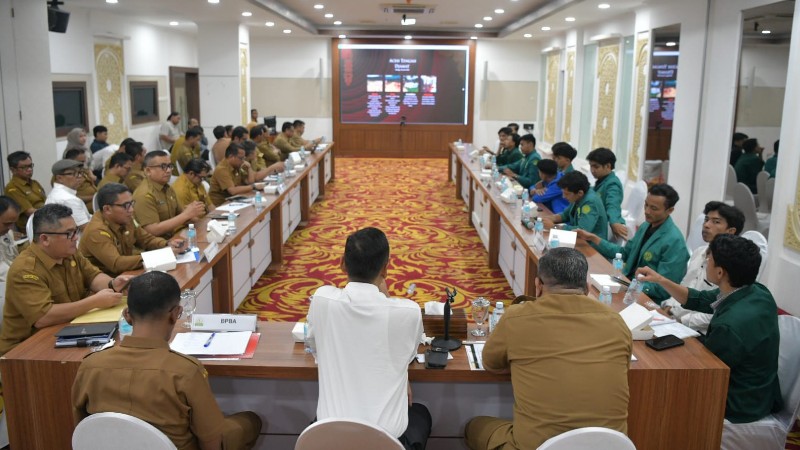
The figure underscores the massive scale of damage within the residential sector. The government considers the provision of adequate housing a top priority because it is directly linked to the welfare and quality of life of the affected population.
To ensure effective implementation of recovery programs, the Aceh Government continues to update and synchronize its data. This process forms an essential part of planning efforts to ensure assistance reaches eligible beneficiaries.The government is also placing strong emphasis on transparent and accurate verification procedures. Reliable data is expected to improve the efficiency of rehabilitation and reconstruction programs while minimizing potential errors in aid distribution.
On the occasion, Nasir again highlighted the importance of additional support from the central government to bridge existing funding gaps. He stressed that collaboration between national and regional authorities remains the key to accelerating Aceh's recovery.The Aceh Government hopes that the required funding can be made available as soon as possible so that all reconstruction programs can be implemented comprehensively. In the long term, these efforts are expected not only to benefit affected communities but also to strengthen the province's resilience against future natural disasters.
Through the dialogue with students, the Aceh Government sought not only to provide updates on recovery progress but also to encourage all segments of society to actively support reconstruction efforts. Cooperation among government institutions, academia, and the public is considered a decisive factor in accelerating regional recovery and ensuring sustainable and effective rebuilding efforts. (IDNC)REPORTER: Adli Safwan | EDITOR: Fik Sagala