

Saturday, 01 August 2026
MEDAN | INDATANEWS.COM - The environmental crisis has become one of the greatest challenges facing modern civilization. This issue is no longer limited to river pollution, forest destruction, climate change, rising carbon emissions, or biodiversity loss. These developments reflect a deeper problem: the weakening of natural resource governance, the decline of ethical responsibility in development policies, and a legal system that has yet to adequately ensure a balance between economic interests and environmental protection.
The massive exploitation of natural resources demonstrates a development approach that continues to view nature primarily as an economic commodity. As a result, ecological damage is increasing, land conflicts are intensifying, the quality of life for many communities is declining, and the right of future generations to a healthy environment is becoming increasingly threatened. This situation highlights the need for a new legal paradigm—one that is not merely an instrument for imposing sanctions but also a foundation for a civilization that respects ecological justice and sustainable living.
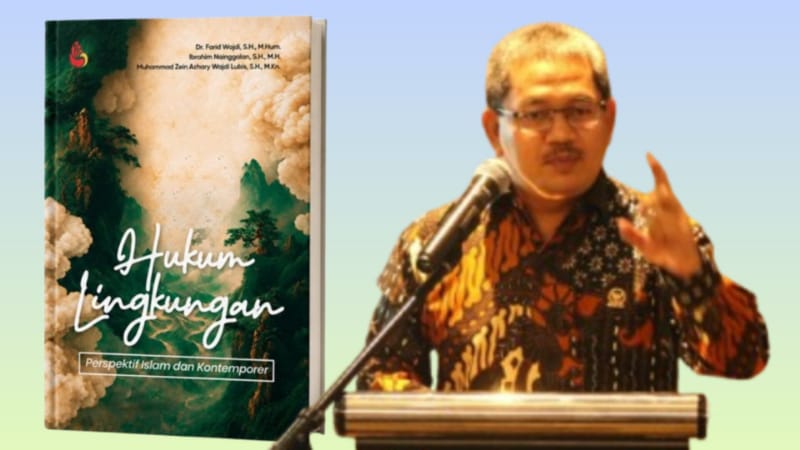
Driven by academic necessity and intellectual responsibility, the book Environmental Law from Islamic and Contemporary Perspectives by Farid Wajdi, Ibrahim Nainggolan, and Muhammad Zein Azhary Wajdi Lubis presents a new perspective on environmental law. Published in 2026 by Setara Press Malang with ISBN 978-634-7099-26-6, the book offers an approach that differs from many previous environmental law publications in Indonesia.
The analysis goes beyond positive legal norms and administrative regulations by developing a comprehensive synthesis of national law, international environmental law, legal philosophy, ecological ethics, Islamic values, and global environmental policy developments.
The book's main strength lies in its understanding of environmental law as a multidimensional discipline. Nature is not viewed merely as an economic resource that can be exploited for investment purposes but as a trust that must be protected through legal, moral, social, and spiritual approaches.
This perspective demonstrates the close relationship between concepts such as khalifah fil ardh (human responsibility as guardians of the Earth), amanah (trust), mīzān (balance), and maqāṣid al-syarī'ah (the objectives of Islamic law) with modern environmental law principles, including the precautionary principle, the polluter pays principle, public participation, state responsibility, and intergenerational equity.
This integration shows that Islamic values can contribute significantly to the development of modern environmental law and support a more just direction for sustainable development.
Through critical and argumentative analysis, the book challenges a development model that considers economic growth as the sole measure of progress. Investment remains important for national development; however, it loses its meaning when achieved through ecosystem destruction, increasing environmental disasters, the loss of indigenous communities' habitats, declining public health, and growing social burdens for future generations.
Development that ignores ecological limits only creates an illusion of progress because short-term economic gains can never compensate for permanent environmental damage.
The book emphasizes that the effectiveness of environmental law does not depend solely on administrative instruments, civil lawsuits, or criminal sanctions. Effective law enforcement requires institutional integrity, transparent governance, strong public oversight, community participation, and a growing moral awareness among all stakeholders.
Regulations without an ethical foundation remain merely legal texts without transformative power, while environmental destruction continues due to weak supervision and a lack of accountability.
Another distinctive aspect of the book is its presentation of Islamic teachings as a source of inspiration for developing modern environmental law. Values derived from the Quran and Sunnah are explained contextually through concepts such as fasād fi al-arḍ (destruction on Earth), lā ḍarar wa lā ḍirār (no harm and no mutual harm), hisbah (social responsibility), and sadd al-dzarī'ah (preventing harmful consequences).
These principles are understood as foundations for public policies that promote environmental protection. The approach demonstrates the harmony between Islamic legal principles and international environmental law developments in creating fair, sustainable, and life-supporting natural resource management.
The book also discusses developments in international environmental law, climate change, corporate responsibility, environmental disputes, green economy, energy transition, Environmental, Social and Governance (ESG), and the challenges of artificial intelligence in environmental management.
The interdisciplinary approach, combining law, philosophy, theology, economics, environmental science, and public policy, produces a comprehensive, systematic, and accessible analysis.
More than an academic work, this book presents a proposal for a new paradigm of legal development in Indonesia. It encourages readers to view environmental law as an instrument of social transformation that connects legal certainty, ecological justice, spiritual values, and sustainable development.
Protecting nature is not merely a political decision but also a constitutional obligation, a moral responsibility, and a measure of civilization's progress—one that respects present life without sacrificing the rights of future generations. (IDNC)
By: Dr. Farid Wajdi, S.H., M.Hum
The author is the founder of Ethics of Care, a member of Indonesia's Judicial Commission (2015–2020), and a lecturer at UMSU.

 /home/u7391150/public_html/indatanews.com/theme/function.php on line 28