Thursday, 17 September 2026
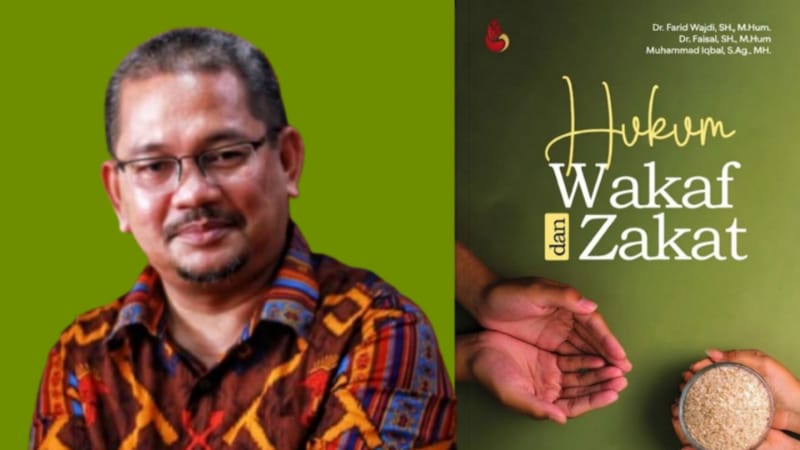
MEDAN | INDATANEWS.COM - The development of the Islamic economy in recent years has demonstrated increasingly dynamic growth. Alongside this progress, there is a rising demand for literature that comprehensively explains waqf and zakat. Academics, practitioners, philanthropic institution managers, and policymakers require references that not only discuss legal aspects but also connect them with Islamic economic theory, institutional governance, regulation, and contemporary social challenges.
To address this need, the book "Hukum Wakaf dan Zakat" (Waqf and Zakat Law), ISBN 978-634-7099-37-2, has been published. Released by Setara Press, Malang, the book provides an in-depth analysis of two fundamental instruments of Islamic economics that contribute significantly to social development and the prosperity of Muslim communities.
The book was written by Farid Wajdi, Faisal, and Muhammad Iqbal. It systematically discusses the foundations of the Islamic economic system, the concept of ownership, the fundamental principles of waqf and zakat, their historical development, international management practices, and recent reforms in the regulation and governance of waqf and zakat in Indonesia.The contents are structured to help readers gain a comprehensive understanding of the relationship between Islamic principles, legal frameworks, institutional structures, and the demands of modern economic development.
The main strength of "Hukum Wakaf dan Zakat" lies in its multidisciplinary perspective. The study does not focus solely on fiqh-based legal and normative aspects but is enriched by analyses of Islamic economics, institutional governance, public policy, and the development of productive waqf models in various countries.
This approach provides a broader perspective on the role of waqf and zakat as strategic instruments for promoting social justice, strengthening economic empowerment, and supporting sustainable national development.The book also explains the philosophical foundations of Islamic economics, where wealth is viewed as a trust that must be managed responsibly. Wealth is not regarded as an absolute individual right but as a means to create collective welfare.
From this perspective, economic activities should establish a balance between individual interests and social needs. Therefore, waqf and zakat are presented as distribution mechanisms that ensure the circulation of wealth, strengthen social solidarity, and expand public access to education, healthcare, and social services.These challenges include asset management, strengthening legal frameworks, professionalizing Nazir (waqf administrators), and improving institutional transparency and accountability.
The analysis highlights possible directions for waqf law reforms so that the vast potential of waqf assets can be optimally utilized for public interests.In addition to waqf, the book provides a comprehensive discussion of zakat. It explains zakat as a wealth distribution instrument with both social and economic functions. The role of the National Zakat Agency (BAZNAS), Zakat Management Institutions (LAZ), the development of productive zakat programs, and the contribution of zakat toward economic empowerment are analyzed in a contextual and systematic manner.
Readers are encouraged to understand zakat not only as an individual religious obligation but also as a social policy instrument that, when professionally managed, can contribute to poverty alleviation and improving community welfare.Another advantage of the book is its communicative yet academically grounded presentation. Each discussion is based on classical and contemporary sources, combining strong arguments with accessible language.
Therefore, the book is suitable as university teaching material, a research reference, and a guide for judges, lawyers, notaries, government officials, waqf and zakat administrators, as well as Islamic economics professionals.More than a discussion of legal norms, "Hukum Wakaf dan Zakat" offers a new perspective on Islamic philanthropy as an effective development instrument. Waqf and zakat are presented as forces capable of promoting economic equality, improving public services, expanding social participation, and supporting a fairer and more sustainable economic system.
With its broad scope, comprehensive analysis, and strong relevance to the development of Islamic law and Islamic economics in Indonesia, this book serves as an important reference for anyone seeking to understand waqf and zakat holistically."Hukum Wakaf dan Zakat" not only enriches Islamic legal literature but also provides a new perspective on the role of Islamic philanthropy in building a more inclusive, productive, and equitable economic future for Indonesia. (IDNC)
By: Farid Wajdi, S.H., M.HumThe author is the founder of Ethics of Care, a member of the Judicial Commission (2015–2020), and a lecturer at UMSU.





 /home/u7391150/public_html/indatanews.com/theme/function.php on line 28