Sunday, 11 October 2026
JAKARTA | INDATANEWS.COM - Indonesia's Ministry of Manpower is piloting a hybrid vocational training model that combines classroom instruction at government-run vocational training centres with practical placements directly within companies. The programme forms part of the government's efforts to address skills gaps in the labour market and prepare skilled workers to meet the needs of businesses and industry.
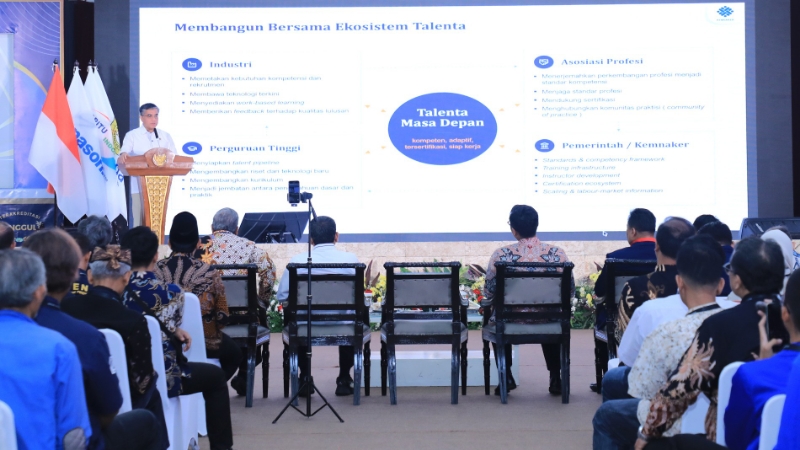
The model combines practical vocational training with hands-on experience in industrial workplaces. Participants gain not only theoretical knowledge and technical skills at training centres but also the opportunity to apply what they have learnt under real working conditions.Indonesia's Minister of Manpower, Yassierli, said that developing vocational training required an integrated ecosystem involving various stakeholders. Cooperation between the government, industry, professional associations and universities was essential to ensure that training content kept pace with technological developments and labour market demands.
"The hybrid model is currently being piloted in South Sumatra, with several major industrial companies participating, including Bukit Asam, Pusri Palembang and Pertamina," Yassierli said on Thursday, 8 October 2026, during a national seminar on heating, ventilation, air conditioning and refrigeration (HVACR) in Jakarta.The pilot scheme highlights the government's efforts to strengthen links between vocational training institutions and industry. By involving companies in developing workers' skills from the outset, the programme aims to produce skilled workers whose abilities match workplace requirements.
Under the hybrid training model, participants initially undertake one to two months of intensive instruction at government-run vocational training centres. Once this phase is complete, they continue their training through practical placements at industrial companies participating in the programme.
This approach enables participants to learn the fundamentals of their chosen occupations while gaining first-hand experience of applying their skills in professional working environments. Practical experience also helps them develop a better understanding of safety standards, workplace procedures, the use of equipment and the level of care required to carry out tasks properly.The government covers all training costs, allowing participants to complete the programme without paying fees for vocational qualifications. They also receive a competency certificate free of charge.
Free training and certification are important elements of efforts to widen access to vocational education. For jobseekers, free training can reduce the financial barriers to gaining additional qualifications. A competency certificate also provides evidence of their abilities and may improve their employment prospects.However, the programme's success will depend on more than the number of people taking part. Other crucial factors include the alignment of curricula with industrial requirements, the quality of trainers, the facilities available for practical instruction and the recognition of acquired competencies by employers. These factors will largely determine how effectively the programme can create additional employment opportunities.
By involving industry in the practical training phase, companies can assess the abilities of potential workers at first hand. Training institutions, meanwhile, can receive feedback on the skills most in demand. This information can help them adapt their teaching materials to technological changes and current occupational standards.
According to Yassierli, the heating, ventilation, air conditioning and refrigeration (HVACR) sector offers considerable potential for job creation.
Climate change and rising temperatures in many parts of the world are increasing demand for cooling equipment in both households and industry. Cooling systems are also essential to the operation of numerous facilities, including office buildings, shopping centres, healthcare facilities and storage sites where specific temperatures must be maintained.Growing demand is creating employment opportunities for skilled workers with technical expertise in installing, maintaining and repairing cooling equipment. However, the increasing demand for such equipment must be matched by a sufficient supply of qualified technicians who understand installation standards and can work accurately.
HVACR technicians need knowledge of mechanical components, electrical systems, air circulation and the use of refrigerants. They must also be familiar with inspection and maintenance procedures to maintain system performance and reduce the risk of technical failures.Particular attention must be paid to proper installation and regular maintenance, as technical errors can lead to refrigerant leaks. Some refrigerants have a high global warming potential, meaning their release can increase environmental harm. Technicians must therefore understand the correct handling of refrigerants, the inspection of connections and the testing of equipment in accordance with applicable safety standards.
These skills not only help meet industrial demand but also promote more efficient use of energy and resources. Properly installed and maintained cooling systems can operate more efficiently, while the correct handling of refrigerants can help reduce environmentally harmful emissions.Employment opportunities in the HVACR sector also demonstrate why vocational training must keep pace with changing societal needs and industrial developments. As demand for cooling technologies grows, certified technicians with practical experience can play an important role in meeting companies' workforce requirements.
These centres provide an important foundation for the government's efforts to expand access to vocational education. Their distribution across the country means training opportunities can potentially reach more jobseekers and people seeking to improve their skills in line with the needs of local economies.
However, the availability of training centres and qualified trainers must go hand in hand with regular curriculum updates, modern practical training facilities and stronger partnerships with businesses. Technological advances are creating new skills requirements across numerous occupations. Training institutions must therefore continuously adapt their programmes to current industry needs.In the HVACR sector, for example, participants need to acquire not only technical skills but also knowledge of workplace safety, energy efficiency and the proper handling of refrigerants. This combination is essential to ensure that graduates meet professional standards and keep pace with the growing range of modern cooling technologies.
Cooperation with industry can help vocational training centres identify skills requirements more accurately. Companies can provide information on occupational standards, technologies in use and the capabilities future employees need to develop. Universities and professional associations can also contribute by advancing technical knowledge, competency standards and training quality.For the public, hybrid training offers a pathway to acquiring vocational skills more closely aligned with actual employment opportunities. For industry, the model can also provide a way to identify potential employees who already possess fundamental technical knowledge and practical experience.
In the long term, the programme's effectiveness should be assessed through measurable outcomes. These should include successful competency assessments, job placements, the alignment of acquired skills with available vacancies and employment stability after training. Such indicators can help the government evaluate the programme and identify the skill areas that should receive priority support in the future.By strengthening vocational education and expanding partnerships with industry, the government aims to bring companies' workforce requirements into line with workers' readiness for employment. Training in the HVACR sector illustrates how demand-driven vocational education can improve employment prospects while responding to technological developments and environmental challenges. (IDNC)
REPORTER: Ahmad Zulfikar | EDITOR: Fik Sagala