Friday, 18 September 2026
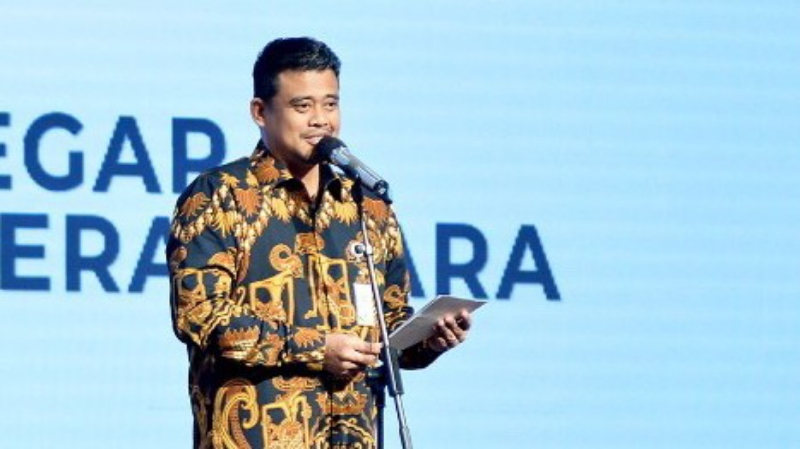
MEDAN | INDATANEWS.COM - North Sumatra Governor Bobby Nasution, together with the province's 33 regional heads, has signed a joint commitment with the Corruption Eradication Commission (KPK) aimed at improving governance and strengthening corruption prevention at the regional level.
The signing took place on Thursday, September 17, 2026, as part of a coordination meeting on strengthening local governance and corruption prevention within the regional administration of North Sumatra. The event was held at the Raja Inal Siregar Hall at the North Sumatra Governor's Office on Jalan Diponegoro Number 30, Medan.The joint commitment involved not only the provincial government and the governments of regencies and cities, but also the respective speakers and chairpersons of regional legislative councils. The measure is part of efforts to improve governance, particularly in planning, budgeting, and the procurement of goods and services.
Bobby said corruption prevention requires a comprehensive approach. In his view, regional governments cannot handle the task alone because governance involves numerous interconnected stakeholders."We hope that the eradication and prevention of corruption in North Sumatra will be carried out comprehensively because North Sumatra, as well as other regions, consists of many stakeholders, and they are naturally interconnected," Bobby said.
Bobby reaffirmed that the North Sumatra Provincial Government, together with the 33 regional heads and regional legislative councils, is committed to improving governance while strengthening integrity in the implementation of government responsibilities.
According to Bobby, the presence of the KPK at the forum provided an important opportunity to once again remind all levels of government to consistently implement corruption prevention measures. At the same time, a shared awareness must be established so that prevention efforts do not stop at a ceremonial event."Together with the other regional heads and regional legislative councils, we are committed to making improvements, preventing corruption and taking measures to eradicate it. The presence of the KPK today reminds us once again to continue strengthening our integrity," Bobby Nasution said.
The signing of the joint commitment was preceded by the reading of the shared declaration. Bobby led the reading, which was supported by the regional heads and chairpersons of the regional legislative councils of regencies and cities throughout North Sumatra.The commitment is aimed at strengthening administrative processes and ensuring that they are more transparent and in accordance with applicable regulations. Regional governments are also expected to ensure that every stage of government administration is based on a clear legal and administrative framework, allowing potential irregularities to be prevented at an early stage.
The coordination meeting also highlighted the importance of strengthening governance. Corruption prevention, therefore, is not limited to measures taken only after a violation has occurred. Internal control systems and early monitoring are considered important components for ensuring that administrative processes remain compliant with regulations.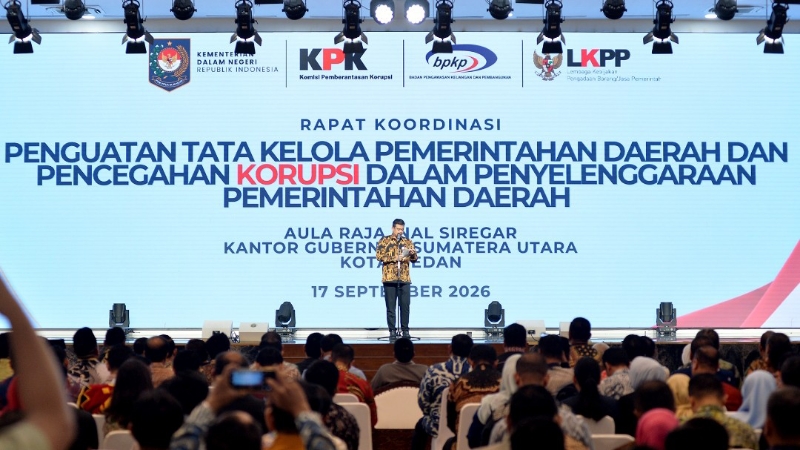
KPK Chairman Johanis Tanak emphasized the importance of Government Internal Supervisory Apparatus, known as APIP, in establishing a stronger corruption prevention system in the regions. In his view, APIP must have a sufficiently strong institutional position so that it can carry out its supervisory function independently and provide early warnings to regional heads and government officials about potential risks.
Johanis called on the Ministry of Home Affairs to strengthen the position of APIP in the regions. He proposed a mechanism under which regional heads would not be able to dismiss internal supervisory officials without following a specific approval process."We need to strengthen the position of APIP. It should not only be selected at the regional level, but should also receive approval from the Ministry of Home Affairs. This would prevent regional heads or other officials from simply dismissing them. The decision should come from the Ministry of Home Affairs and subsequently be given a legal basis through a presidential regulation," Johanis said.
According to Johanis, strengthening APIP is important for establishing an early warning system within government administration. With a stronger institutional position, internal supervisors can better identify potential irregularities before they develop into legal problems.The discussion concerning APIP has also received particular attention at the central government level. Stronger internal oversight is regarded as one approach that can enable regional governments to identify and correct administrative errors at an early stage.
Deputy Minister of Home Affairs Akhmad Wiyagus also emphasized the central role of APIP in preventing corruption offenses within regional governments. He explained that APIP can identify irregularities at an early stage and provide regional governments with an opportunity to make corrections before a case reaches the legal enforcement stage.
According to Wiyagus, regional governments should regard APIP as a partner in carrying out government responsibilities rather than as an institution to be avoided. Through such cooperation, internal supervision can serve both as a corrective instrument and as a prevention mechanism."When APIP has a high level of quality, government will function better. If there is an irregularity, before it is referred to law enforcement authorities, there is an opportunity for restitution or correction. If that is also not carried out, the case will be referred to law enforcement authorities. APIP is a partner of the regional government, not an institution that should be avoided," Akhmad said.
Wiyagus also emphasized at the meeting the need to strengthen APIP so that it can perform its supervisory function optimally. Internal supervisors can alert regional heads to errors in governance and thereby enable corrections to be made at an early stage.In addition to strengthening internal controls, regional governments must also pay attention to areas that carry heightened risks in governance. These include planning and budgeting, the procurement of goods and services, public services, civil service administration, the management of regional government-owned enterprises, and the optimization of regional tax revenues.
Wiyagus also urged regional governments to translate the results of the coordination meeting into measurable action plans. For each problem, concrete solutions, responsible parties, deadlines, and evidence of implementation should be established. This would allow progress in improvement measures to be monitored regularly.He also emphasized the importance of cooperation between regional governments and regional legislative councils in overseeing governance and regional finances, including planning and budgeting processes.
The coordination meeting was also attended by Deputy Head of the KPK's Coordination and Supervision Division Ely Kusumastuti, Chairwoman of the North Sumatra Regional Legislative Council Erni Ariyanti Sitorus, Acting Regional Secretary of North Sumatra Timur Tumanggor, as well as representatives of the Financial and Development Supervisory Agency (BPKP) and the National Public Procurement Agency (LKPP).All regents and mayors in North Sumatra, chairpersons of the regional legislative councils of regencies and cities, and relevant regional agencies within the North Sumatra Provincial Government also attended the event.
Through the joint commitment, regional governments across North Sumatra have placed improved governance and stronger internal controls on their shared agenda as key components of corruption prevention. The forum also brought together regional governments, regional legislative councils, the KPK, the Ministry of Home Affairs, BPKP, and LKPP to strengthen coordination on regional governance.Through stronger internal controls and the involvement of all relevant stakeholders, prevention efforts are expected to begin at the planning stage and continue through the implementation of government programs, rather than only being initiated after a problem has already occurred. (IDNC)
REPORTER: Edi Saputra | EDITOR: Fik Sagala





 /home/u7391150/public_html/indatanews.com/theme/function.php on line 28