Thursday, 17 September 2026
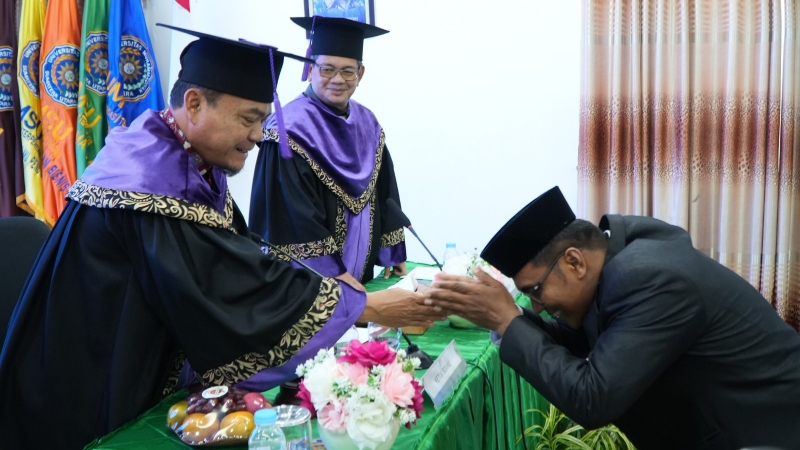
MEDAN | INDATANEWS.COM - Waqf of protected trees has the potential to become an instrument of green philanthropy that combines religious values with environmental conservation and sustainable development. This idea forms the focus of a dissertation entitled "Wakaf Pohon Lindung, dan Potensi Pengembangannya di Indonesia" ("Protected Tree Waqf and Its Development Potential in Indonesia"), through which Dr. Kusnan earned his doctoral degree from the Doctoral Program in Law at the Postgraduate Faculty of Universitas Muhammadiyah Sumatera Utara (UMSU).
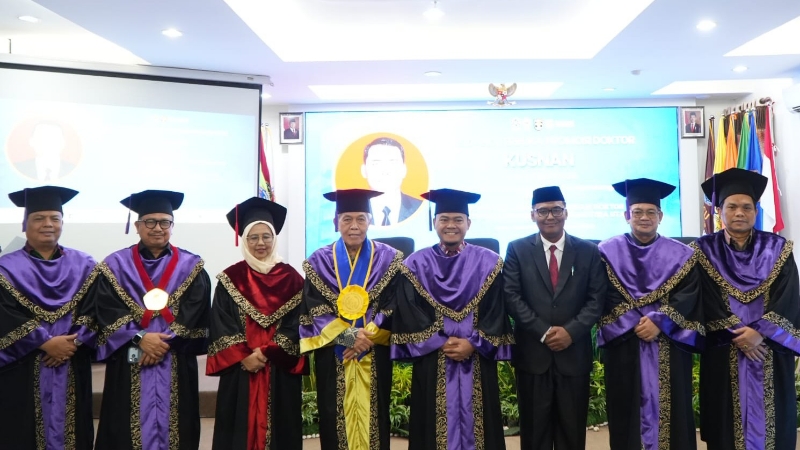
Dr. Kusnan defended his dissertation on September 16, 2026, during a public doctoral examination held by UMSU's Doctoral Program in Law. The examination was chaired by UMSU Vice Rector for Resources and Finance, Prof. Dr. Muhammad Qorib, MA.Prof. Dr. Muhammad Arifin, S.H., MHum., served as Kusnan's principal supervisor, while Dr. Farid Wajdi, S.H., M.Hum., served as co-supervisor. The examination panel comprised Prof. Dr. Tarmizi, S.H, M.Hum., Dr. Ramlan, S.H, M.Hum., and Dr. Ida Nadirah, S.H, M.H.
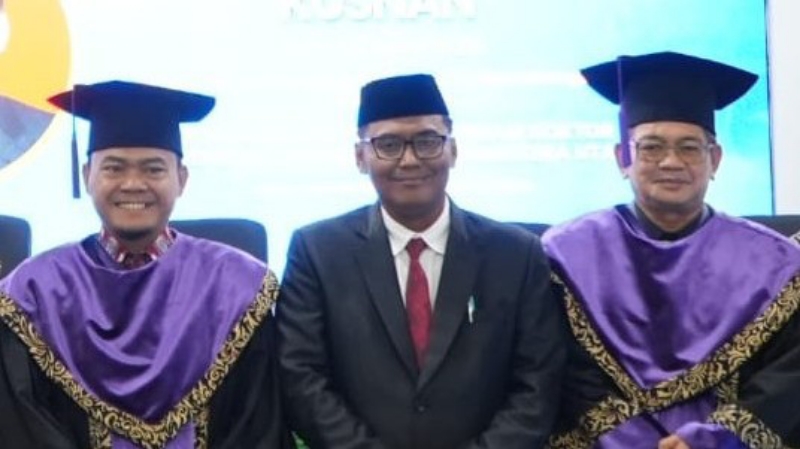
Dr. Kusnan became the 58th graduate of UMSU's Doctoral Program in Law, earning his doctorate with a "very good" distinction. Several of his colleagues from the Medan City Ministry of Religious Affairs, the Medan Regional Leadership of Muhammadiyah, and the Medan Regional Leadership of Aisyiyah also attended the academic event.Dr. Kusnan serves as deputy chairman of the Medan Regional Leadership of Muhammadiyah and is responsible for the organization's Majelis Tabligh and Tarjih.
In his dissertation, Dr. Kusnan examines the growing environmental crisis, which he says requires greater public attention. Deforestation, climate change, and ecosystem destruction threaten both ecological balance and people's long-term livelihoods.
According to Dr. Kusnan, the scale of environmental degradation has reached a worrying level. He describes how large areas can be affected by environmental destruction within a very short period.In his view, the situation requires greater public awareness and participation in protecting and restoring the environment. Kusnan therefore proposes protected tree waqf as an approach that could be further developed to address these challenges.
He explains that trees perform important ecological functions, including absorbing carbon and helping maintain ecological balance. Protected tree waqf, therefore, should not be viewed solely from the perspective of worship and philanthropy, but also in terms of its long-term ecological benefits.Waqf practices in Indonesia have so far largely focused on land, buildings, and other conventional assets. Kusnan believes this approach should be expanded to include assets that serve ecological functions and contribute to environmental sustainability.
"Protected tree waqf has the potential to be developed as an instrument of green philanthropy that connects religious values, nature conservation, and sustainable social benefits," said Dr. Kusnan.This idea represents a key focus of his research. Kusnan views waqf not only as a socio-religious instrument but also examines its potential role in nature conservation and environmental protection.
From the perspective of Islamic law, protected tree waqf can be considered valid because it is consistent with the principle of tahbis al-asl wa tasbil al-manfa'ah. This concept provides that the underlying waqf asset is preserved while its benefits are directed toward the public interest.
Dr. Kusnan also links protected tree waqf to the concept of sadaqah jariyah and the objectives of Islamic law (maqasid al-syari'ah), particularly hifz al-nafs, hifz al-mal, and hifz al-bi'ah. Through this approach, waqf could generate broader benefits for both people and the environment.From the perspective of Indonesian positive law, protected tree waqf has constitutional and statutory foundations, including the 1945 Constitution of the Republic of Indonesia, Law No. 41 of 2004 on Waqf, and Law No. 32 of 2009 on Environmental Protection and Management.
Dr. Kusnan, however, notes that the existing legal framework does not yet explicitly regulate the implementation of protected tree waqf. This includes matters concerning legal status, asset protection, management, supervision, and the preservation of the long-term ecological functions of trees dedicated as waqf assets.He therefore considers it necessary for the government to issue implementing regulations that can provide a foundation for communities, waqf managers (nazhir), and other stakeholders to systematically develop protected tree waqf.
His research finds that protected tree waqf has strategic potential as an instrument of ecological philanthropy. Its development could connect nature conservation, climate mitigation and adaptation, sustainable economic activity, community empowerment, environmental education, and sustainable development.
Dr. Kusnan sees this as an opportunity to broaden the benefits of waqf. With proper management, trees dedicated as waqf assets could provide not only ecological benefits but also support economic activities within communities and strengthen environmental awareness.In the concluding section of his dissertation, Kusnan recommends that the government formulate implementing regulations for protected tree waqf. In his view, these regulations should establish the status, designation, management, protection, and supervision of waqf assets.
Clear regulations are also necessary to prevent the conversion or exploitation of waqf assets that have ecological functions.Dr. Kusnan also advocates the development of an integrated and collaborative management model for protected tree waqf. Under this model, waqf managers (nazhir), the government, communities, and relevant economic and social sectors could work together to ensure that the ecological, economic, and social benefits of tree waqf are realized to their fullest potential.
He further recommends integrating protected tree waqf into environmental protection and sustainable development programs. This could include the development of green financing models, community empowerment initiatives, climate mitigation measures, and environmental education.Through this approach, protected tree waqf is intended not to remain merely an academic concept, but to develop into a form of philanthropy that provides long-term benefits for society and the environment.
In his conclusion, Dr. Kusnan emphasizes that regulating protected tree waqf constitutes a legal necessity with the character of daruriyyah to support environmental protection and safeguard people's livelihoods.He also concludes that protected tree waqf is, in principle, permissible and legally justifiable from both the perspective of Islamic law and Indonesia's positive legal system. Its development potential can be directed toward connecting environmental conservation, climate mitigation and adaptation, sustainable economic activity, community empowerment, environmental education, and sustainable development.
The idea also broadens the perspective on waqf in Indonesia: moving beyond the exclusive use of conventional assets toward the development of assets that provide long-term ecological and social benefits. (IDNC)AUTHOR: Dr. Farid Wajdi, S.H., M.Hum | EDITOR: Fik Sagala



 /home/u7391150/public_html/indatanews.com/theme/function.php on line 28