Friday, 04 September 2026

LABUHANBATU SELATAN | INDATANEWS.COM - Deliberations on the amendment to the 2026 Regional Budget (APBD) of Labuhanbatu Selatan Regency have reached a crucial stage. During a plenary session of the Labuhanbatu Selatan Regional Legislative Council (DPRD) on Tuesday, September 1, 2026, Labuhanbatu Selatan Regent Fery Sahputra Simatupang presented the region's revised fiscal structure. Regional revenue is projected to reach Rp970.12 billion.
The revised projection represents an increase of Rp181.48 billion from the original pre-amendment budget, which had set regional revenue at Rp788.64 billion.At the same session, all eight factions of the Regional Legislative Council approved the draft Regional Regulation on the Election of Village Heads (Pilkades). The draft will now proceed toward enactment as a Regional Regulation (Perda). The move also paves the way for simultaneous village head elections planned to take place across the regency in January 2027.
The plenary session began at around 2 p.m. Western Indonesia Time at the Labuhanbatu Selatan DPRD plenary hall. Deputy Speaker of the Regional Legislative Council Irma Yanti Siregar, S.H., chaired the session. A total of 25 of the council's 35 members were in attendance.Also present were representatives of the Regional Leadership Coordination Forum (Forkopimda), the Labuhanbatu Selatan regent, the regional secretary, the DPRD secretary, several heads of regional agencies, community representatives, social organizations and non-governmental organizations.
In his opening remarks on the draft amendment to the 2026 Regional Budget, Fery Sahputra said the regional government had prepared the budget amendment based on the revised regional development planning for Labuhanbatu Selatan in 2026.
The planning process also referred to Minister of Home Affairs Regulation Number 14 of 2025 concerning guidelines for the preparation of regional budgets for the 2026 fiscal year.Fery stressed that an amendment to the Regional Budget should not merely be treated as an administrative process for adjusting figures in budget documents. Every change in fiscal policy, he said, must have a direct impact on the public interest and support the implementation of regional development programs.
"The preparation of the amended Regional Budget continues to adhere to the principles of an orderly, efficient, economical, effective, transparent and accountable budget, while taking into account fairness, appropriateness, public benefit and compliance with applicable laws and regulations," Fery said during the plenary session.Under the proposed amendment, Labuhanbatu Selatan's regional revenue in the 2026 revised budget is projected at Rp970.12 billion. This represents an increase of Rp181.48 billion, or approximately 23 percent, compared with the original budget projection of Rp788.64 billion.
The revenue consists of Rp105.61 billion in locally generated revenue, Rp851.75 billion in transfer funds and Rp12.76 billion in other legitimate regional revenue.The increase in projected revenue is an important factor in determining the region's fiscal capacity and the direction of its development policies for the remainder of the 2026 fiscal year.
The significant change in projected revenue also places an obligation on the regional government to ensure that budget funds are managed effectively and transparently and deliver tangible benefits to the public.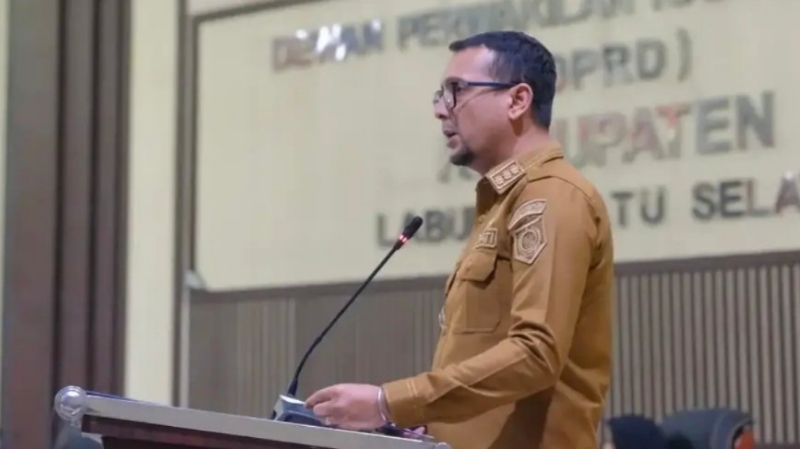
In addition to the Regional Budget amendment, the Labuhanbatu Selatan DPRD plenary session also addressed regulations governing the election of village heads. All eight factions expressed their approval of the draft Pilkades regulation and supported its enactment as a Regional Regulation.
Despite their approval, several factions raised concerns, particularly regarding the regional government's preparedness for the possible implementation of electronic voting, or E-Voting, in the elections.The Hanura faction, through Doni Iron Surbakti, urged the regional government not to rush into implementing such a system. He said the government must first ensure the readiness of all parties involved in conducting the village elections.
According to him, preparations must cover technological infrastructure, personnel, election committees, security systems and mechanisms for dealing with potential technical disruptions during voting."The electronic implementation of the Pilkades, or E-Voting, must not create the impression that the people are being used as guinea pigs. The government and relevant authorities must prepare the election committees more thoroughly and comprehensively," he stressed.
The Hanura faction's concerns demonstrate that the Regional Legislative Council views the draft Pilkades regulation as more than merely a legal document. The regulation must provide a foundation to ensure that democratic processes at the village level are conducted in an orderly, secure, transparent and accountable manner.The Perindo faction, through Wandika Lahagu, also called on the regional government to ensure that all stages of the village elections are conducted safely and peacefully.
He stressed that the principles of direct, universal, free, confidential, honest and fair elections must remain the foundation of the Pilkades process.Should the government decide to adopt an E-Voting system, he said the technology must support the electoral process. It must strengthen transparency and efficiency rather than create new problems that could undermine public confidence in the election results.
She said the Pilkades regulation was important because it would serve as the legal basis for democratic participation at the village level. The regulation must also be aligned with provisions governing the terms of office of village heads.
Ayu further said that the regional government had already informed the public about the planned village elections and had received a positive response. Several preparatory measures for the Pilkades had also been initiated since the process began.Following the agreement between the DPRD and the regional government to enact the Pilkades draft as a Regional Regulation, attention now turns to implementation. The regional government therefore faces the equally important task of ensuring that the new regulation can be effectively implemented in practice.
The simultaneous village head elections in Labuhanbatu Selatan Regency are scheduled to take place in January 2027. With the planned election date approaching, the regional government must ensure that all requirements for the elections are in place.These preparations include the legal framework, election organizers, voting infrastructure, security measures, technological readiness in the event that E-Voting is used, and public understanding of the electoral process.
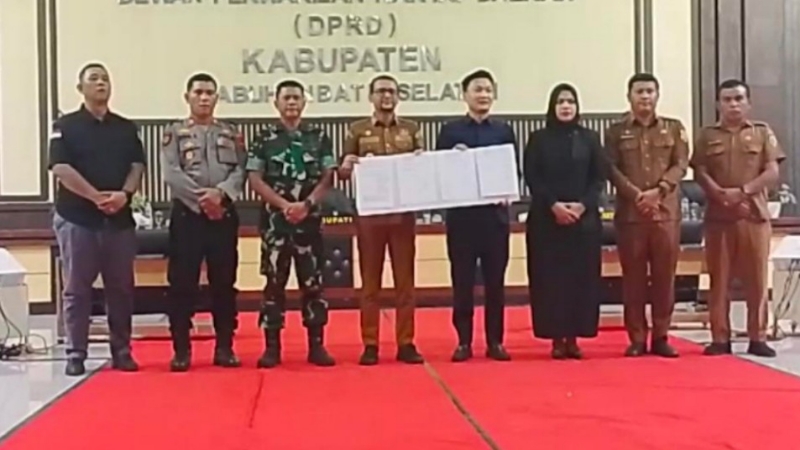
Public information and education are also essential components. The success of the Pilkades will depend not only on the preparedness of election organizers but also on voters' understanding of each stage and the voting procedures, enabling them to exercise their voting rights directly, freely, confidentially, honestly and fairly.The plenary session subsequently concluded with the signing of the agreement memorandum on the Pilkades regulation draft by the Labuhanbatu Selatan regent and the leadership of the Regional Legislative Council.
From the Labuhanbatu Selatan DPRD plenary hall, two strategic issues therefore dominated the proceedings. The first was the amendment to the 2026 Regional Budget, with projected revenue of Rp970.12 billion, an increase of Rp181.48 billion from the original budget.The second was strengthening the legal foundation for the village elections through the enactment of the Pilkades draft as a Regional Regulation. This serves as preparation for the planned simultaneous village head elections in January 2027.
The work of the regional government and Regional Legislative Council does not end with the agreement reached in the plenary hall. The next challenge is to ensure that the Regional Budget amendments drive development and provide tangible benefits to the public. At the same time, the Pilkades regulation must serve as the foundation for a safe, orderly, transparent and integrity-driven democratic process at the village level.Ultimately, the success of both strategic initiatives will be measured by their implementation. The figures contained in the amended Regional Budget must be translated into concrete programs that genuinely reach the public. Meanwhile, the Pilkades regulations must ensure that villagers can exercise their democratic rights fairly and responsibly. (IDNC)
REPORTER: Jhon Fitra Sagala | EDITOR: Fik Sagala





 /home/u7391150/public_html/indatanews.com/theme/function.php on line 28