Thursday, 01 October 2026
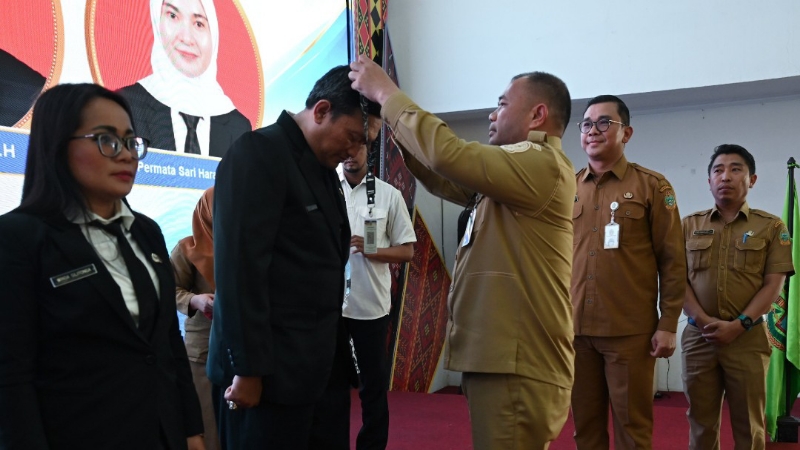
MEDAN | INDATANEWS.COM - Acting Secretary of the North Sumatra Provincial Government Timur Tumanggor has called on all participants of the 2026 Administrator Leadership Training (PKA) and Supervisory Leadership Training (PKP) to implement the change projects they have developed within their respective work units.
According to Timur, the change projects should not merely serve as requirements for completing the training programs. Every innovation developed by participants must have a concrete impact on improving organizational performance while also enhancing the quality of public services.Timur made the statement while opening the 2026 PKA and PKP programs on Monday, September 28, 2026, at the Beringin Hall on the fifth floor of the North Sumatra Provincial Human Resources Development Agency (BPSDM), located at Jalan Ngalengko No. 1, Medan.
In his remarks, Timur emphasized that leadership training plays an important role in developing civil servants. Participants are expected not only to master administrative duties but also to be capable of leading change within the bureaucracy."Leadership training is a strategic instrument for improving the leadership competence and capabilities of State Civil Apparatus (ASN) personnel. Civil servants are not only expected to be able to carry out administrative duties, but also to make decisions, solve problems, build cooperation and adapt to change," Timur said.
Timur urged participants to pay attention to three key aspects during the training and after returning to their respective work units. The first is integrity.
According to Timur, every position carries a responsibility that must be exercised by civil servants with the highest sense of accountability. Therefore, participants should exercise their authority appropriately, perform their duties transparently and avoid practices that could harm themselves or the organization.He said integrity is an important foundation for building public trust in the bureaucracy. Civil servants who consistently uphold integrity can exercise their authority more professionally and take greater responsibility for the decisions they make.
As the second priority, Timur highlighted an outcome-oriented approach. He called on participants not to focus solely on routine activities and completing administrative tasks, but to ensure that every activity produces tangible benefits for the public.This outcome-oriented approach, Timur said, must be reflected in program planning, decision-making, resource utilization and the evaluation of work results. In this way, the bureaucracy should not merely produce documents but provide concrete responses to the needs of the public.
The third aspect is innovation and collaboration. Timur explained that the increasing complexity of government responsibilities requires cooperation among various stakeholders, as not every problem can be resolved by a single agency or administrative unit."I hope this training will produce change leaders who are capable of simplifying work processes, accelerating services, increasing the efficiency of budget utilization and implementing innovations in their respective work units," he said.
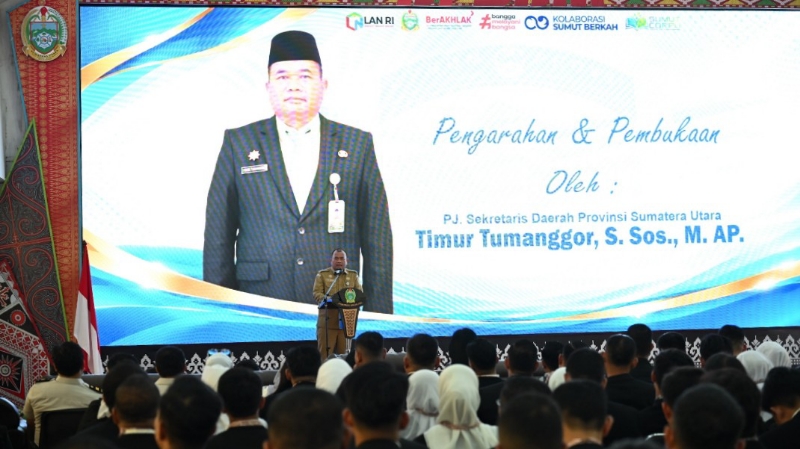
"A change project is not merely a ceremonial requirement within the training program. It must actually be utilized and implemented in the organization after the PKA or PKP training is completed," he stressed.
He expressed hope that the projects could serve as instruments for improving work processes within the public administration. Participants must also ensure that the innovations they develop simplify work processes, accelerate services, improve the efficiency of budget utilization and provide tangible benefits to the public.Timur also called on participants to bring new perspectives and initiatives back to their respective work units. He encouraged them to work more quickly, make appropriate decisions and resolve various problems that arise in carrying out their duties.
Furthermore, Timur views the participants' diverse professional backgrounds as an opportunity to strengthen the learning process. Participants from different agencies can exchange knowledge and experiences throughout the training."The different institutions represented by the participants are a strength in themselves. There is an opportunity here to learn from one another and exchange ideas and experiences. Let us build a professional, integrity-driven, innovative and results-oriented bureaucracy in North Sumatra," he said.
According to Agustinus, the training is not solely focused on improving participants' capabilities in carrying out leadership responsibilities. It also provides opportunities to build networks, broaden professional perspectives and strengthen cooperation across government agencies.
"In addition to improving competencies, the training also serves as a platform for strengthening leadership networks and inter-agency cooperation among participants, instructors, coaches, mentors and assessors," he said.Agustinus said a total of 288 participants are taking part in the 2026 PKA and PKP programs. Of that number, 154 participants are enrolled in PKA, while 134 participants are enrolled in PKP.
The participants come from the North Sumatra Provincial Government, regency and municipal governments across the province, as well as vertical government agencies. The organizers plan to conduct both training programs through December 18, 2026.Through the implementation of the PKA and PKP programs, the North Sumatra Provincial Government seeks to strengthen the competencies of its civil servants so they can perform their leadership responsibilities more effectively. The competencies acquired during the training are also expected to be directly applied in carrying out duties within their respective organizations.
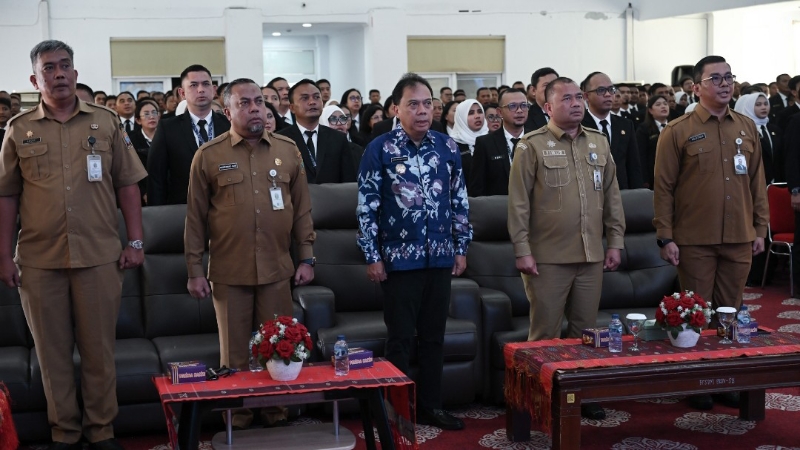
Among those attending the opening were Deputy Regent of South Tapanuli Jafar Syahbuddin Ritonga, Assistant for General Administration at the North Sumatra Provincial Government Secretariat Muhammad Suib, as well as heads of human resources development agencies from regencies and municipalities.With participants representing various institutions, the 2026 PKA and PKP training also serves as a forum for civil servants to exchange experiences. The North Sumatra Provincial Government hopes the process will help strengthen results-oriented leadership within the bureaucracy and support sustainable improvements in public services. (IDNC)
REPORTER: Ahmad Zulfikar | EDITOR: Fik Sagala



 /home/u7391150/public_html/indatanews.com/theme/function.php on line 28