Sunday, 25 October 2026
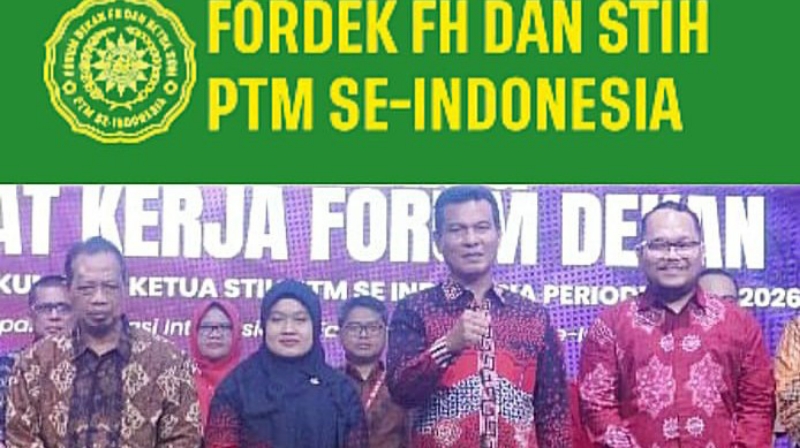
YOGYAKARTA | INDATANEWS.COM - The Forum of Deans of Law Faculties at Muhammadiyah Higher Education Institutions across Indonesia (Fordek FH PTM) has urged the Indonesian House of Representatives (DPR RI) to take constitutional steps to address Constitutional Court (MK) Decision No. 01/PHPU.PRES-XXIV/2026. The ruling concerns a legal dispute over the results of the presidential and vice-presidential election.
The forum has also called on the Election Organisers' Ethics Council (DKPP) to examine the ethical aspects of the election process. In addition, it has advocated revisions to the Election Law and urged civil society and academics to help oversee and safeguard compliance with the Constitution.The position was made public following the Constitutional Court's delivery of its ruling in the case on 6 October 2026. The petition had been submitted by 12 applicants from civil society, political parties and the general public. The court declared the petition inadmissible because the applicants lacked the required legal standing. The Constitutional Court's official documentation confirms the decision.
In its constitutional analysis, Fordek FH PTM highlights the relationship between the eligibility requirements for presidential and vice-presidential candidates, legal certainty, the integrity of election administration and the accountability of public officials. The forum argues that administrative issues relating to candidate eligibility should not be treated merely as matters of document verification. Instead, they must be assessed in accordance with the law and the principles of the rule of law.The forum considers the prescribed minimum educational qualification a fundamental requirement that must comply with the applicable legislation. In this context, Fordek FH PTM refers to Article 169(r) of Law No. 7 of 2017 on Elections. The provision stipulates that presidential and vice-presidential candidates must hold at least a senior secondary school qualification or an equivalent educational certificate.
In its statement, the forum questions the relationship between statutory provisions and the technical regulations issued by the General Elections Commission (KPU), particularly Article 18(3) of KPU Regulation No. 19 of 2023. Fordek FH PTM argues that technical regulations must neither weaken nor override requirements established by law.The forum also stresses the importance of distinguishing between documents that certify knowledge or participation in an educational programme and those that demonstrate the attainment of a formal qualification. According to its legal argument, this distinction must be carefully considered when verifying the eligibility of candidates for public office.
However, the legal status of individual documents and the significance of the court's reasoning must be assessed against the full text of the Constitutional Court's ruling. A petition being declared inadmissible because of a lack of legal standing does not automatically mean that the court has upheld the substantive claims or recognised all the applicants' allegations as established legal facts.
In connection with constitutional accountability, Fordek FH PTM has urged the DPR RI to consider whether to exercise its right to issue a formal statement of opinion (Hak Menyatakan Pendapat, HMP) and begin deliberations on possible impeachment proceedings against Vice-President Gibran Rakabuming Raka.
The forum bases its request on its interpretation of the eligibility requirements for the vice-presidential office and the legal considerations surrounding the proceedings before the Constitutional Court. Fordek FH PTM believes that any potential discrepancies in meeting fundamental candidate eligibility requirements should be examined through the available constitutional mechanisms.However, impeachment proceedings are not automatically triggered by an organisation's statement, political objections or a particular interpretation of a court ruling. Articles 7A and 7B of the 1945 Constitution of the Republic of Indonesia set out the grounds and procedures for removing the President or Vice-President from office during their term.
The process involves the DPR, the Constitutional Court (MK) and the People's Consultative Assembly (MPR). The DPR must first follow the constitutionally prescribed procedure for submitting its formal opinion. The Constitutional Court then examines, hears and decides on the DPR's opinion in accordance with the Constitution. If the court upholds the DPR's position, the proceedings continue before the MPR, subject to the applicable requirements and procedural rules.Fordek FH PTM's demand should therefore be understood as a call for Parliament to examine the matter through constitutional channels. It does not constitute a decision to remove the Vice-President from office. Every stage of the process must respect the powers of state institutions, the rights of the individuals concerned and the applicable standards of evidence.
The forum also emphasises the need to distinguish between political and legal accountability. In a presidential system, political disagreements or dissatisfaction with an office-holder's performance do not automatically provide grounds for removing an elected official. Any impeachment must be based on the grounds and procedures expressly established by the Constitution.The call for an ethics investigation represents a recommendation from Fordek FH PTM. Whether an ethical violation has actually occurred must be determined by the DKPP through proceedings conducted in accordance with the applicable regulations.
Fordek FH PTM has also called on the government and the DPR RI to revise the Election Law. The forum is seeking stricter standards for verifying candidate eligibility documents, better alignment between technical regulations and statutory provisions, and transparent public access to information about the requirements for the country's highest public offices.In the forum's view, reforms should prevent differing interpretations that could lead to legal disputes and undermine public confidence in the conduct of elections. Clear administrative standards could help election bodies make consistent decisions while providing greater legal certainty for election participants and the public.
Fordek FH PTM also maintains that the disclosure of documents should comply with the applicable rules on public information and data protection. In this way, transparency could strengthen public scrutiny without disregarding legal restrictions on access to certain information.The forum further reminds the public that electoral integrity is an essential component of democratic quality. Transparent election procedures, accountable administrative verification and effective dispute-resolution mechanisms are necessary to maintain public confidence in democratic institutions.
The forum also underlines the importance of critical thinking when addressing legal and political questions. According to its recommendations, academic investigations should rely on official documents and verifiable legal arguments. They must clearly distinguish between facts established during court proceedings, the applicants' allegations and conclusions actually contained in the operative part of the ruling and the judges' reasoning.
Fordek FH PTM regards the supremacy of the Constitution and popular sovereignty as fundamental principles that must operate in harmony. Popular sovereignty gives elected leaders their democratic legitimacy, while the Constitution and legislation establish the limits of their powers and the requirements that public officials must fulfil.Through its recommendations, the forum has set out five key demands: the DPR should examine the exercise of its right to issue a formal statement of opinion and the possibility of impeachment in accordance with the Constitution; the DKPP should investigate potential ethical violations in election administration; the Election Law should be revised; the MPR should observe the constitutionally prescribed procedures; and academics and civil society should critically monitor the implementation and interpretation of the Constitutional Court's ruling.
The development places legal certainty, transparency in candidate eligibility and the accountability of state institutions at the centre of discussions about democratic governance in Indonesia. How Fordek FH PTM's recommendations will be handled depends on the respective powers of the institutions concerned and the applicable legal procedures.For the public, the matter is also a reminder that democratic oversight requires access to verifiable information, careful legal analysis and respect for constitutional procedures. Criticism of public officials remains legitimate. However, conclusions about potential legal violations and their consequences must be based on appropriate evidence and pursued through the lawful procedures established for that purpose. (IDNC)
REPORTER: H. Muhammad Said Harahap | EDITOR: Fik Sagala