Saturday, 24 October 2026
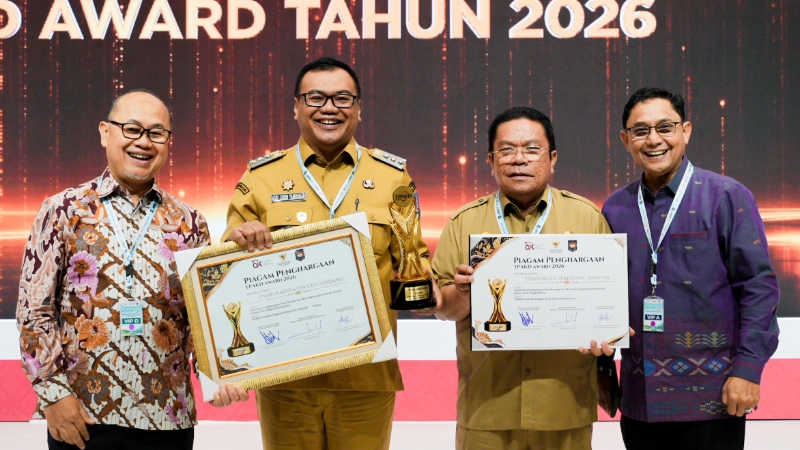
JAKARTA | INDATANEWS.COM - Deli Serdang Regency in Indonesia's North Sumatra province has been named the best regional committee for accelerating financial access (TPAKD) at regency level in the Sumatra region for 2026. Deli Serdang Regent dr H. Asri Ludin Tambunan personally received the award on Thursday, 22 October 2026, during the national TPAKD coordination meeting in Jakarta, which was also attended by Indonesian President Prabowo Subianto.
The award recognises the regional government's efforts to expand public access to financial services. The programme aims not only to help more people access formal financial services but also to encourage the use of financing for productive economic activities, business development and higher household incomes.Regent Asri Ludin Tambunan said the award recognised the Deli Serdang Regency Government's efforts to improve financial access for local communities. He expressed hope that the achievement would encourage the regional administration to continue expanding inclusive financial services so that more families could benefit.
"Alhamdulillah, hopefully this award will further motivate us to expand access to inclusive financial services for all families so that they can improve their prosperity. We want financing opportunities not merely to be available, but also to support productive businesses, increase incomes and improve the welfare of people in Deli Serdang," he said."The true strength of the national economy must be felt directly by the people. By farmers in villages, fishers along the coasts, traders in markets, MSME entrepreneurs and women who struggle to contribute to their family incomes," the President said.
Prabowo also announced plans to expand lending to economically active communities to as much as 400 trillion rupiah in 2027. The programme is expected to benefit around 28 million families, with particular attention given to farmers and fishers."Next year, I want to distribute 400 trillion rupiah to farmers and fishers in the regions," he said.
The President emphasised that expanding financing opportunities must go hand in hand with responsible resource management and prudent use of public funds. The central and regional governments, he said, must ensure that the country's economic potential directly benefits the public rather than being reflected solely in economic growth figures.During the same event, Prabowo announced the establishment of a National Council for Financial Wellbeing. The new institution is intended to strengthen policy coordination to improve both access to financial services and public welfare.

Airlangga explained that encouraging people to open bank accounts or use financial products was not enough. They also needed to understand how to use these services properly, protect their finances and strengthen their financial resilience when facing economic pressures.
"What we assess is resilience and also financial security," Airlangga said.He added that the government was expanding financial access through various programmes, including student savings accounts, the distribution of government assistance and productive financing. These initiatives are intended to promote equal economic opportunities and help people use formal financial services for productive purposes.
Friderica Widyasari Dewi, Chair of the Board of Commissioners of Indonesia's Financial Services Authority (OJK), reported that the country's financial services sector had remained resilient despite pressure from global economic conditions. Indonesia's economy grew by 5.4 per cent in the first half of 2026, while bank lending increased by 13.69 per cent.During the same period, bank deposits reached approximately 10,400 trillion rupiah. Friderica said credit growth had made an important contribution to financing national economic activity.
"This lending volume is the highest in the past ten years. It undoubtedly provides a significant foundation for supporting national economic growth," she said.Friderica also reported that Indonesia's financial literacy rate had reached 69.57 per cent, while more than 93 per cent of the population had access to financial services in 2026. She attributed these results to cooperation between the central government, the OJK, Bank Indonesia and regional administrations, which have worked together to improve public understanding of and access to formal financial services.
"This result has already exceeded the target set in the National Medium-Term Development Plan (RPJMN) for 2029. It is the result of very good cooperation between the government, the OJK, Bank Indonesia and all regional governments, including regency and city administrations throughout Indonesia," she said.Friderica explained that Indonesia had 552 TPAKD committees operating at provincial, regency and city levels. These committees coordinate programmes to expand financial access in line with the needs and economic potential of their respective regions. Their initiatives include business financing and support for productive economic activities.
The OJK is also working to ensure that more small business owners, farmers and other groups in need of capital can obtain financing. By providing financing suited to their needs, these groups are expected to develop their businesses, increase production and achieve sustainable income growth.
Home Affairs Minister Tito Karnavian highlighted the importance of fiscal incentives in encouraging regional governments to improve their development performance. He explained that this year's fiscal incentives were being distributed through a competition, with the performance achieved by each region serving as the basis for allocation.
Towards the end of 2026, Tito said, the government was also discussing another round of competition to assess regional performance. This would include a category recognising the highest economic growth. In his view, fiscal incentives could help improve development outcomes and strengthen programmes that deliver direct benefits to the public."This year, one trillion rupiah has been allocated to the Ministry of Home Affairs, which we distribute through a competition. I have already discussed this with the President and the Finance Minister today. We are continuing to seek an increase in the fiscal incentives allocated to the Ministry of Home Affairs so that more funding can be distributed to the regions next year," he said.
Tito expressed hope that the government would increase fiscal incentive funding next year, enabling more regions to receive support based on their performance. He also urged regional administrations to strengthen their development programmes, including initiatives to improve financial access for residents and businesses.The award for Deli Serdang forms part of broader efforts to expand financial access at regional level. The next challenge is to ensure that people do not merely gain access to bank accounts, banking services and financing, but also use these opportunities to develop their businesses, strengthen their families' economic resilience and improve their living standards.
The success of these programmes will depend on consistent policy implementation, coordination between the institutions involved and the ability of regional governments to reach communities that have so far had limited access to capital. In this way, broader financial inclusion can contribute to more balanced and sustainable economic growth. (IDNC)REPORTER: Edi Saputra | EDITOR: Fik Sagala