Monday, 26 October 2026
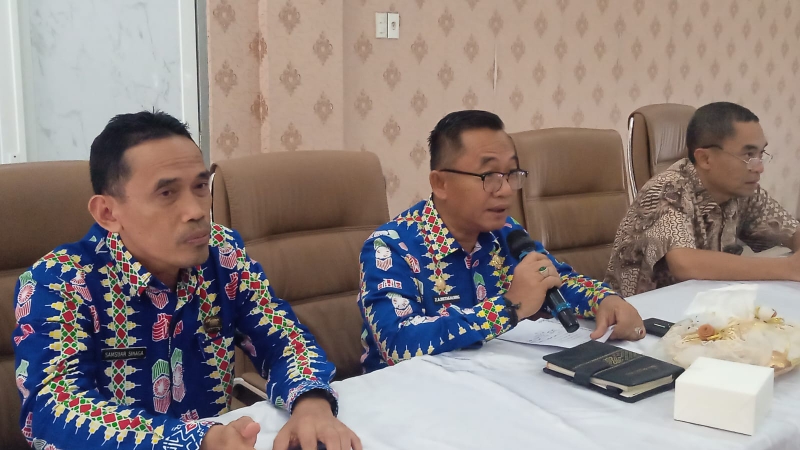
DELI SERDANG | INDATANEWS.COM - The Deli Serdang Regency Government is strengthening cross-sector coordination to support the implementation of the 13-year compulsory education program and accelerate efforts to address the number of children who are out of school. These efforts were the focus of a Focus Group Discussion (FGD) on 13-year compulsory education and addressing the number of out-of-school children, held on Thursday, August 20, 2026, in the second-floor hall of the Deli Serdang Education Office.
The forum brought together various government agencies and education stakeholders to discuss concrete steps and ensure that children in Deli Serdang Regency continue to have access to education. The regional government believes that the issue of out-of-school children cannot be resolved by a single agency, as the causes are diverse and linked to social, economic and geographical conditions, as well as family circumstances.Zainal Abidin Hutagalung, Assistant for Government Affairs and Public Welfare at the Deli Serdang Regional Secretariat, chaired the FGD. He directed the discussion toward reconciling data on out-of-school children from various sources, identifying the causes of children being out of school, and preparing follow-up measures tailored to conditions in each area.
Zainal emphasized that the government must have accurate data to ensure that every measure taken for out-of-school children is genuinely focused on problems at the local level. Reconciling data from various sources is an important step toward gaining a more comprehensive understanding of the circumstances of affected children.
According to Zainal, education is a fundamental right of every citizen and, at the same time, a long-term investment in regional development. Therefore, the government and all elements of society must give special attention to children who still lack access to educational opportunities.He explained that the implementation of 13-year compulsory education cannot rely solely on the Education Office. The regional government needs the support of all regional government agencies, governments at the Kecamatan, village and Kelurahan levels, businesses, educational institutions and the community.
"Addressing the issue of out-of-school children must be carried out in an integrated manner, based on accurate data, strong coordination and concrete action in the field. Through cooperation among all stakeholders, we are optimistic that we can reduce the number of out-of-school children while increasing the school attendance rate in Deli Serdang Regency," he said.The Deli Serdang Regency Government considers data reconciliation an important component in determining appropriate strategies. With more valid data, the government can more accurately identify which children are not attending school, understand their living conditions and determine the factors preventing them from attending school.

The range of factors shows that different approaches are required in different areas to address the problem of out-of-school children. For example, a child who has dropped out of school for economic reasons requires different assistance from a child whose access to education is hindered by geographical conditions or a change of residence.
The FGD participants then used the results of the data reconciliation and problem analysis as a basis for developing solutions. The regional government called on all relevant agencies not to limit their efforts to data collection, but to take concrete action for children identified as out of school or considered at increased risk of dropping out.This approach also requires an active role from governments at the village and Kelurahan levels. Authorities that are closest to residents can help assess the situation of children in their respective areas, including through data collection, dialogue with families and referring children to existing educational programs.
In addition to the government, the community also plays an important role in ensuring the continuity of children's education. Public awareness of the importance of education must be continuously strengthened so that families understand the long-term impact of education on their children's future and on regional development.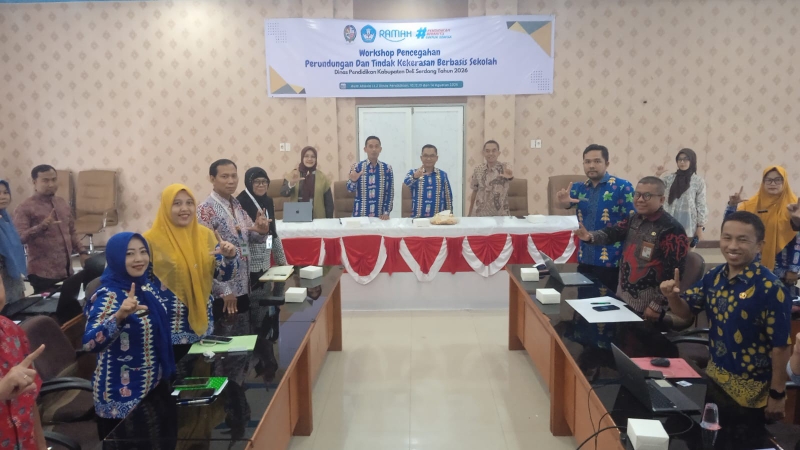
The FGD produced several follow-up measures to strengthen efforts to address the issue of out-of-school children in Deli Serdang Regency. The regional government plans to strengthen coordination among government agencies so that every issue can be addressed in an integrated manner and agencies do not work independently of one another.
The government also plans to improve data validity and optimize the role of village and Kelurahan governments in data collection. This step is essential to provide the government with a more accurate picture of the number and circumstances of children who are out of school in each area.Alongside improving data collection, the government will increase public awareness of the importance of education. These efforts will be accompanied by assistance for children at risk of dropping out and children who have already left school, giving them opportunities to resume their education.
The results of the FGD can subsequently serve as a basis for the regional government to develop more targeted measures and programs. The government hopes this approach will enable it to address the issue of out-of-school children according to the characteristics and needs of each area, rather than applying a one-size-fits-all approach.Strengthening cross-sector cooperation is also part of the Deli Serdang Government's commitment to ensuring that every child has equal opportunities to receive quality education. According to the regional government, the success of 13-year compulsory education depends not only on the availability of educational services, but also on the ability of all stakeholders to ensure that children remain within the education system.
Through continuous coordination, regular data updates, assistance and community participation, the Deli Serdang Government is optimistic that it can continue reducing the number of out-of-school children while increasing the school attendance rate.These efforts are part of the regional government's steps to develop Deli Serdang into a healthy, educated, prosperous, religious and sustainable regency.
The FGD was also attended by the Head of the Deli Serdang Education Office and his staff, representatives of various regional government agencies, vertical government agencies, representatives from the Kecamatan level, as well as several education stakeholders. The participation of these various institutions strengthened the shared commitment to building a coordinated and sustainable system to address the problem of out-of-school children.By involving multiple sectors, the government hopes that efforts to address children being out of school will not only produce more valid data, but also generate programs that enable children to return to the education system. This step is also an important component in ensuring that the 13-year compulsory education policy is effectively implemented and reaches every child in Deli Serdang Regency. (IDNC)
REPORTER: Edi Saputra | EDITOR: Fik Sagala