Sunday, 08 November 2026

MEDAN | INDATANEWS.COM - The North Sumatra Provincial Government is stepping up the registration and verification of prospective social assistance recipients under the Digital Social Protection Programme (Perlindungan Sosial Digital/Perlinsos Digital). The initiative is part of preparations to ensure that welfare assistance in 2027 is distributed more accurately, transparently and on the basis of reliable population data.
As of Friday, 6 November 2026, a total of 1,111,422 households in North Sumatra had registered for Perlinsos Digital. However, the figure remains well below the provincial target of 4,864,605 households. In response, the provincial government plans to strengthen inter-agency coordination and accelerate registration and verification efforts before the end of the year.
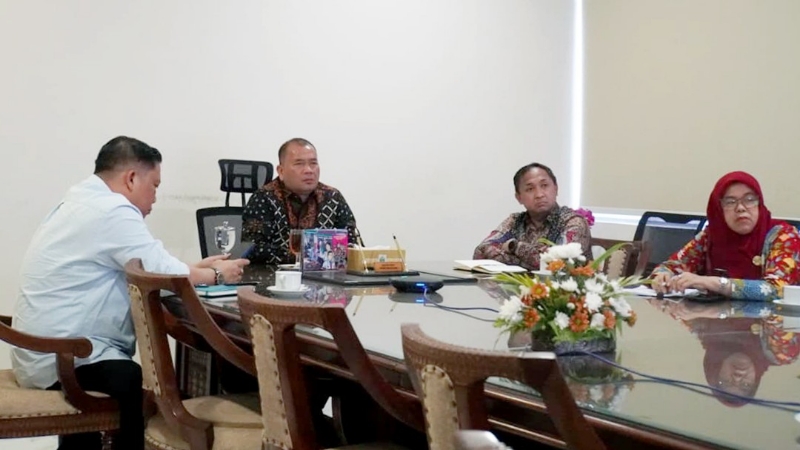
The acting Regional Secretary of North Sumatra, Timur Tumanggor, announced the figures following a virtual coordination meeting on accelerating Perlinsos Digital registration across Indonesia's provinces, regencies and cities. The meeting was held on Friday, 6 November 2026, in the Regional Secretary's meeting room at the North Sumatra Governor's Office, Jalan Pangeran Diponegoro No. 30, Medan.
The meeting was attended by Social Affairs Minister Saifullah Yusuf, Chairman of the Committee for Accelerating the Digitalisation of Social Assistance Luhut Binsar Pandjaitan, and representatives of regional administrations from across Indonesia. Discussions focused on expanding registration and improving the digital system for identifying prospective beneficiaries.
Timur said the provincial government would promptly implement the central government's instructions. Particular emphasis would be placed on strengthening cooperation between regional government agencies (OPD). Verification procedures would also be improved to ensure that registered information accurately reflects the actual circumstances of prospective beneficiaries.
One key priority is the direct matching of biometric data. This process is expected to improve identity verification and minimise errors in identifying eligible social assistance recipients.
According to Timur, Perlinsos Digital is designed primarily to support people in the lowest welfare groups. Registration must therefore reach families who genuinely depend on government assistance.
"The Perlinsos programme is intended for people in welfare deciles 1 to 4, which represent the population groups with the lowest levels of prosperity. Digitalisation is intended to ensure that social assistance, education and healthcare support, as well as energy subsidies, are distributed more accurately and transparently," he said.
Classification into welfare deciles 1 to 4 is an important basis for identifying particularly vulnerable communities. Through integrated data, the government aims to direct various forms of assistance to households according to their actual needs and economic circumstances.
Following the coordination meeting, Timur specifically instructed the North Sumatra Provincial Social Affairs Office to strengthen communication with the Office of Village and Community Empowerment, Population Administration and Civil Registration (PMD Dukcapil), as well as other relevant government agencies.
He stressed that each institution played a different role in providing, matching and updating population data. Close cooperation was therefore essential to speed up registration while maintaining the accuracy of prospective beneficiaries' identity records.
Social Affairs Minister Saifullah Yusuf explained that Perlinsos Digital involves several stages before assistance is distributed. The process begins with household registration, followed by an assessment through the system. Eligible applicants are then nominated for bank accounts before the assistance is finally disbursed.
Under this arrangement, financial assistance will be transferred directly to the registered bank accounts of eligible recipients. The system is expected to improve transparency and help ensure that support reaches the families entitled to receive it.
Saifullah said Indonesia had a total of 96,044,487 households across its 38 provinces. The Social Affairs Ministry aims to register 48 million households, equivalent to approximately 50 per cent of the national total, under Perlinsos Digital.
However, registration figures remain considerably below the target. A total of 18,829,945 households have registered nationwide so far, meaning the government must significantly expand its outreach to achieve the intended coverage.
Among the provinces, Aceh leads with a registration rate of 51.25 per cent, followed by Bali at 50.73 per cent and West Nusa Tenggara at 27 per cent.
North Sumatra has recorded 1,111,422 registered households against its target of 4,864,605. The provincial government is therefore seeking to deploy more registration officers and extend its outreach, particularly to families that have not yet been included in the digital system.
To accelerate progress, Saifullah called on all Perlinsos officers at regency and city level to take a more active approach to engaging residents and assisting them with registration.
According to the Social Affairs Ministry, 1,091,586 programme officers have already registered. They come from various backgrounds, including Family Hope Programme (Program Keluarga Harapan/PKH) facilitators, regional government employees, social welfare workers (PSK), sub-district heads, members of the public, village and neighbourhood administration staff, residential area leaders, and representatives of neighbourhood and community associations.
Saifullah said PKH facilitators had made the largest contribution to registrations, accounting for 40.6 per cent of all registrations completed by programme officers.
"Among the five groups of officers, PKH facilitators account for the largest share of registrations, at 40.6 per cent. I want regional government networks to step up their efforts as well. To accelerate the process, the Social Affairs Ministry is instructing officials to mobilise programme officers in every region. I am therefore calling for inactive officers to be brought into action. Every regional government agency, sub-district head and village administration must ensure that officers who have already registered begin collecting data on residents in their respective areas," he said.
The central government expects all participating groups to play a greater role, particularly regional government employees and administrative structures at village and neighbourhood level. Their involvement is considered essential because of their direct access to local communities and their ability to assist residents who face difficulties with digital registration.

The coordination meeting was chaired by Home Affairs Minister Tito Karnavian, who outlined several measures to accelerate the nationwide digitalisation of social protection.
Tito urged all governors, regents and mayors to step up registration among residents requiring social assistance in their respective areas. Regional administrations were also instructed to work towards registering at least 50 per cent of all households within their jurisdictions.
In addition, he directed governors to monitor Perlinsos Digital registration progress regularly across all regencies and cities. This oversight is intended to help regional administrations track registration figures and identify obstacles that could delay the process.
Tito also called on regional government officials and employees under their supervision to serve as Perlinsos officers. They are expected to help residents complete registration, particularly families in urgent need of assistance who have not yet been recorded in the digital system.
He said digital social protection would benefit not only the central government but also regional administrations by providing a clearer picture of the social and economic conditions of their populations.
"This is beneficial not only to the central government but also to regional administrations. It enables them to identify precisely who needs social assistance so that support can reach the right people. This applies to both financial and in-kind assistance. For regional administrations, the programme can also be a step towards reducing poverty and unemployment.
"We therefore recommend that every region establish its own team. The head of the Social Affairs Office should lead the team, with support from the Population Administration and Civil Registration Office. The Regional Secretary should oversee the programme and assume responsibility on behalf of the respective regional head," he said.
These instructions underline the importance of active regional government involvement in building a more integrated social protection system. Establishing dedicated teams in each region is also expected to clarify responsibilities, strengthen monitoring and speed up the resolution of registration problems.
For North Sumatra, accelerating Perlinsos Digital is a key priority ahead of the planned social assistance distribution in 2027. The provincial government must ensure effective coordination between agencies, active participation by programme officers and reliable verification procedures that produce accurate and accountable data.
With millions of households still to be registered, the programme's success will depend on more than digital technology alone. The commitment of government personnel and public participation will be equally important. Reliable data is essential to ensure that social assistance, education and healthcare support, as well as energy subsidies, reach the families who need them most. (IDNC)
REPORTER: Ahmad Zulfikar | EDITOR: Fik Sagala