Saturday, 24 October 2026
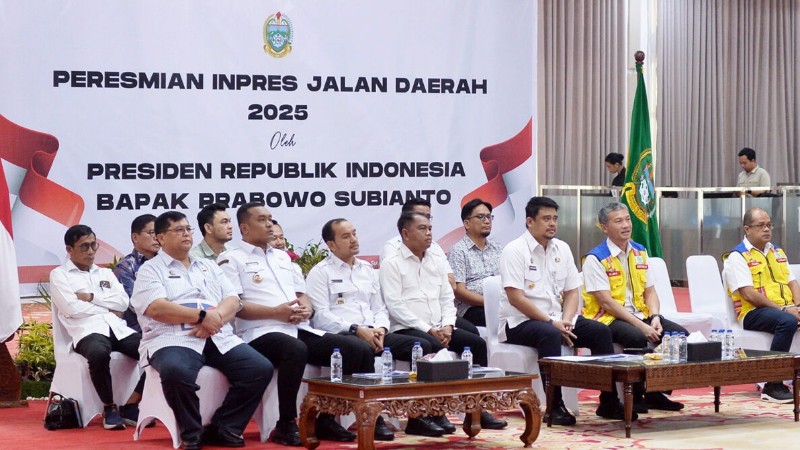
MEDAN | INDATANEWS.COM - North Sumatra Governor, Bobby Nasution, participated in the nationwide inauguration of 1,151 kilometers of regional roads developed under the Presidential Instruction on Regional Roads (IJD) program across 37 provinces in Indonesia. The central inauguration ceremony was led by President Prabowo Subianto in Sampang Regency, East Java, on Tuesday (June 23, 2026).
In North Sumatra, four road construction packages with a total length of 7.10 kilometers were completed under the 2025 IJD program. These road sections were among thousands of kilometers of regional roads officially inaugurated and put into operation across the country.Bobby joined the ceremony via video conference from Tengku Rizal Nurdin Hall at the Governor's Official Residence on Jalan Jenderal Sudirman No. 41, Medan. The inauguration was part of the implementation of Presidential Instruction No. 11 of 2025, which aims to accelerate regional road connectivity in support of national food and energy self-sufficiency.
Also attending the event were Hardy Siahaan, Head of the North Sumatra National Road Implementation Agency under the Ministry of Public Works, Chandra Dalimunthe, Head of the North Sumatra Highways, Construction and Spatial Planning Agency, as well as regional representatives from various districts and cities across the province.The government seeks to strengthen regional connectivity through road development and improvement projects to facilitate the transportation of agricultural products, plantation commodities, fisheries products, and other local flagship commodities. Improved infrastructure is also expected to boost regional economic growth and support national food and energy security programs.

One of the projects involved the rehabilitation of the road connecting the Tebingtinggi City boundary and Sibulan in Serdangbedagai Regency, covering a length of two kilometers. The road serves as a vital link between residential areas and local economic centers.
Another completed project is the Simpang Mangga–Tugu Sujono road in Simalungun Regency, stretching 1.12 kilometers. The road plays a significant role in supporting community mobility and the transportation of regional flagship products.In Toba Regency, the Sirongit–Lancang road was upgraded over a distance of 1.7 kilometers. The infrastructure is expected to improve accessibility for local communities and stimulate economic development in the area.
Meanwhile, Jalan Jenderal Sudirman in Tebingtinggi City was completed along a 2.28-kilometer stretch. The road is one of the city's main transportation corridors and is expected to improve urban traffic flow.Together, the four road sections cover a total length of 7.10 kilometers and form part of the national regional road development program.
In addition to projects carried out under Single Year Contracts, the government is also implementing infrastructure development through Multi Years Contracts (MYC). In North Sumatra, the program covers 19 road sections across 13 regencies and cities.All projects remain under implementation. However, most construction activities have recorded significant progress, with several sections already reaching 100 percent completion and awaiting final administrative and technical processes before becoming fully operational.
These roads are expected to strengthen regional connectivity while improving access to agricultural production centers, plantation areas, and economic hubs that previously faced transportation challenges.Bobby highlighted North Sumatra's national road network, which spans approximately 2,600 kilometers. According to him, most sections are currently in good condition, although several roads still require further attention and improvement to enhance the overall quality of transportation infrastructure.
The governor emphasized that the Presidential Instruction on Regional Roads program provides tangible benefits for communities, particularly in agricultural regions and food production centers. Better road connectivity significantly facilitates the transportation of harvests to distribution centers and markets."Several road sections still require special attention. However, through the IJD program, communities, especially those in agricultural areas and food production centers, have received significant support. The transportation of agricultural products has become much easier, and logistics costs will decline. For that, we should be grateful to the President," Bobby said.
He added that road development not only improves public mobility but also directly enhances logistical efficiency. Reduced travel times and lower transportation costs provide benefits for both farmers and businesses.As a result, products can reach markets more quickly while operational expenses decrease, ultimately improving the competitiveness of regional products.
The North Sumatra Provincial Government therefore hopes to maintain close cooperation between the central and regional governments to ensure that all areas have adequate transportation infrastructure and sustainable economic growth.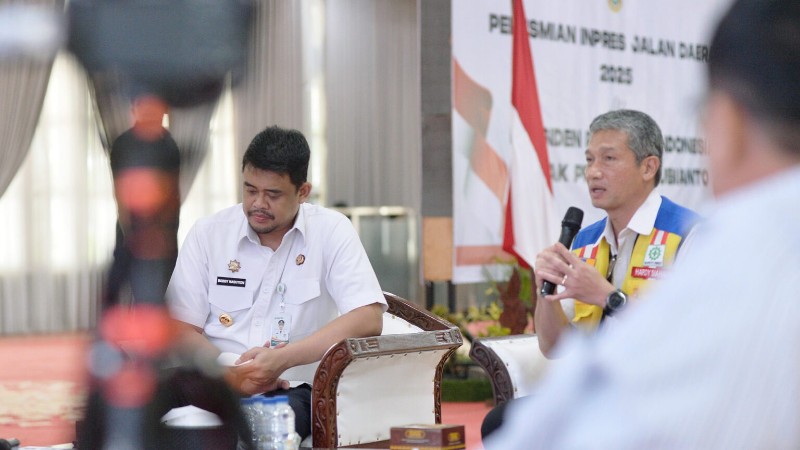
President Prabowo Subianto emphasized the strategic importance of regional roads for national economic growth. Well-developed transportation networks, he said, facilitate the distribution of various products from rural areas to markets and industrial centers.
The President noted that achieving food and energy self-sufficiency depends not only on seeds, fertilizers, irrigation systems, and other production inputs. Equally important is an efficient distribution network capable of delivering products quickly and effectively to consumers.Agricultural products, plantation commodities, fisheries products, and other regional flagship commodities require reliable transportation infrastructure to generate greater economic value for local communities.
"Food self-sufficiency is not only about seeds, fertilizers, or irrigation. Energy self-sufficiency is not only about energy. Equally important is a smooth and well-developed distribution network. With the completion of these roads, I call on regional governments to maintain this infrastructure as effectively as possible," President Prabowo said.The President's remarks underscore that infrastructure development does not end once construction is completed. Regional governments bear the responsibility of maintaining and preserving these assets to ensure long-term benefits for the public.
Through the Presidential Instruction on Regional Roads program, the government expects stronger regional connectivity, more efficient logistics, and increased productivity in agriculture and other economic sectors. Improved infrastructure is expected to accelerate and sustain the achievement of Indonesia's food and energy self-sufficiency goals. (IDNC)REPORTER: Darmailawati | EDITOR: Fik Sagala