Tuesday, 27 October 2026
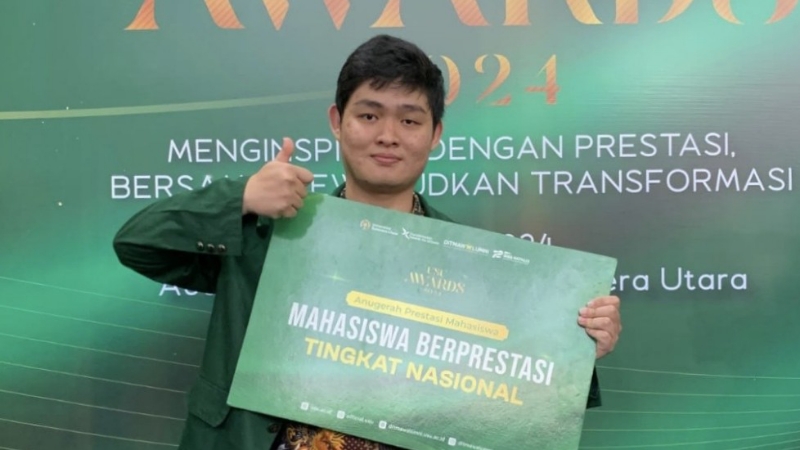
MEDAN | INDATANEWS.COM - Ronny, a student at the Faculty of Public Health at the University of North Sumatra (USU), has developed a technological innovation concept with his team to help preserve historic buildings in earthquake-prone areas. Their research paper, entitled "SMART-TILT: Integrating Digital Twin, IoT Sensors, and Machine Learning for Predictive Structural Health Monitoring of Heritage Buildings in Earthquake-Prone Areas", combines digital twins, Internet of Things (IoT) sensors and machine learning to monitor the condition of building structures and anticipate potential changes.
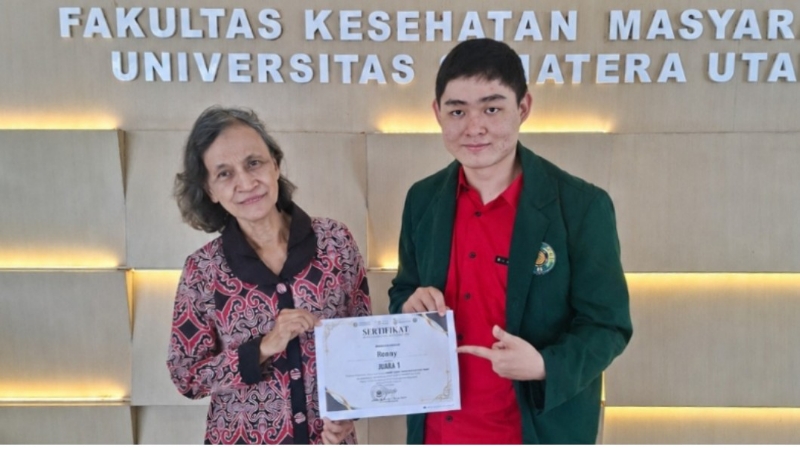
Ronny and his team secured second place in the International Paper Innovation Contest, held as part of the 14th Civil Engineering Innovation Contest at Diponegoro University in 2026. Their achievement highlights how students from different academic disciplines are exploring modern technologies to address challenges in preserving cultural heritage. The research focuses particularly on historic buildings whose structural integrity is threatened by environmental factors and natural disasters.Historic buildings are more than physical structures. They preserve cultural values, history and a community's identity. When such buildings are damaged or destroyed, an important part of the historical heritage may be lost forever. Monitoring methods capable of detecting changes in structural conditions at an early stage therefore offer new opportunities to support the long-term preservation of these buildings.
SMART-TILT emerged from research into the vulnerability of historic buildings, particularly in areas exposed to a heightened risk of earthquakes. Ronny and his team propose a data-driven approach designed to identify signs of structural changes before potential damage develops further.
"I have seen that historic buildings possess considerable value but are also vulnerable to damage, particularly in earthquake-prone regions. SMART-TILT was developed as a concept to enable the early monitoring of structural conditions through data and technology," Ronny said on Tuesday, 27 October 2026.The concept integrates three technological components that perform different but complementary functions. A digital twin creates a digital representation of the physical building, while IoT sensors collect data about its condition. Machine learning then processes this information to support the analysis and prediction of potential changes to the building's structure.
By integrating these three technologies, those responsible for historic buildings could eventually obtain a more measurable and transparent assessment of structural conditions. The information collected could form the basis of a monitoring system designed to identify changes or potential problems at an early stage.However, the system's ability to detect damage will depend on data quality, sensor selection, the analytical methods used and testing under real-world building conditions. SMART-TILT must therefore undergo further development and validation before its effectiveness in practical applications can be reliably assessed.
"The process does not end with finding an idea. We have to understand the problem, examine suitable technologies and then determine how the individual components can work together as a logically structured overall concept," he said.
This process is an important part of developing an innovation that connects digital technologies with the requirements of heritage conservation. Digital twins, IoT and machine learning each have distinct characteristics and place different demands on data processing. The team must therefore develop an approach in which sensor-generated data complements the building's digital representation and provides useful information for monitoring its structural condition.The predictive approach also differs from assessments based solely on observations made at specific points in time. If the technological development and subsequent testing prove successful, data-driven monitoring could help identify changes in a building's condition and provide a better basis for determining whether further investigations are needed.
Nevertheless, the technology cannot replace direct inspections by specialists. Technical assessments remain essential to verify the actual condition of a building's structure, interpret monitoring results correctly and determine appropriate measures. Historic buildings require particular care to ensure that maintenance work preserves their architectural value and original fabric.
As of Tuesday, 27 October 2026, SMART-TILT remains a scientific concept and has not yet been deployed on site. Further technical development, testing and evaluation are therefore necessary to establish the extent to which the system can genuinely support the monitoring of historic buildings.
Ronny hopes his team will be able to develop the concept further, bringing it closer to practical application and enabling it to make a tangible contribution to cultural heritage preservation."I hope this work can be developed further. If the approach is eventually applied in practice, it could help those responsible for historic buildings identify early signs of damage," Ronny said.
The development of SMART-TILT also demonstrates the potential of interdisciplinary collaboration in addressing challenges related to building safety and the preservation of historic structures. Digital technologies can support these efforts, provided their development is based on actual requirements, sufficient data and verifiable test results.Several clearly defined steps will be needed before the concept can be implemented in practice. These include developing a prototype, testing the sensors, building predictive models and validating them on buildings with suitable characteristics. Collaboration with civil engineers, heritage conservation professionals and other relevant authorities could also help ensure that the technology meets the practical requirements of historic building preservation.
Through SMART-TILT, Ronny and his team have presented a concept that seeks to harness technological advances to protect historic buildings from potential damage. Although the research remains at the conceptual stage, it represents an initial step towards exploring early, measurable and heritage-focused structural monitoring. (IDNC)REPORTER: Ahmad Zulfikar | EDITOR: Fik Sagala