Sunday, 13 September 2026
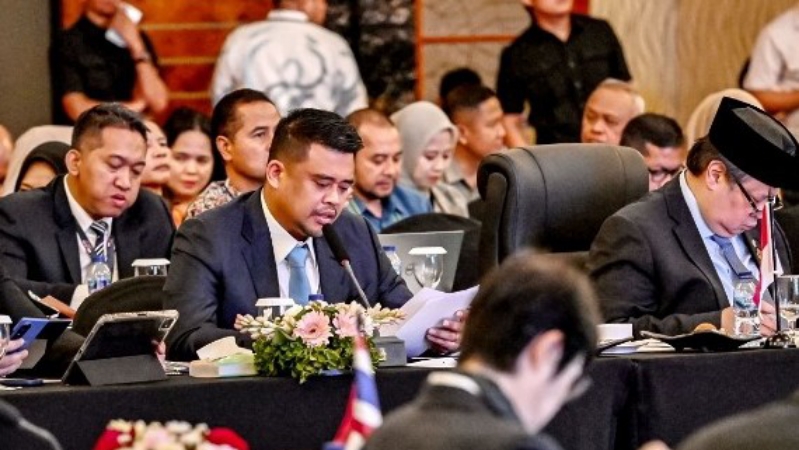
MEDAN | INDATANEWS.COM - North Sumatra Governor Bobby Nasution presented several strategic projects and investment opportunities in the province at the 32nd Ministerial Meeting of the Indonesia-Malaysia-Thailand Growth Triangle (IMT-GT) in Medan.
His presentation highlighted North Sumatra's importance as one of the strategically significant regions for strengthening connectivity, investment and regional economic growth across the Indonesia-Malaysia-Thailand subregion.
Bobby Nasution made the presentation in his capacity as Chairman of the Chief Ministers' and Governors' Forum (CMGF) during the reporting session on the final day of the 32nd IMT-GT Ministerial Meeting at the JW Marriott Hotel Medan on Thursday, September 10, 2026.
On the occasion, Bobby introduced several flagship projects in North Sumatra that are considered to have significant potential to drive economic growth while strengthening the province's position within the regional cooperation network.
"In North Sumatra, we are pleased to report on the Sei Mangkei Special Economic Zone, covering an area of 1,934 hectares. There is also the Toba Caldera Resort at Lake Toba, with an investment value of US$1.73 billion, the Strategic Industrial Estate of North Sumatra (KISS), covering 2,445 hectares, as well as an integrated creative economy, MICE and Smart City center in Deli Serdang," Governor Bobby said.
The projects presented by Bobby span industry, tourism, economic zones and integrated urban development. The Sei Mangkei Special Economic Zone is among the projects receiving particular attention, covering an area of 1,934 hectares.
In addition, North Sumatra is offering the Toba Caldera Resort in the Lake Toba area, with an investment value of US$1.73 billion. The project is part of the development of the Lake Toba tourism area and is also expected to enhance North Sumatra's appeal to international investors.
Bobby also presented the Strategic Industrial Estate of North Sumatra (KISS), which covers 2,445 hectares. The development of the estate is expected to support industrial and economic activities across North Sumatra.
The North Sumatra Provincial Government is also offering the development of an integrated center for the creative economy, Meetings, Incentives, Conferences and Exhibitions (MICE), as well as Smart City concepts in Deli Serdang.
The investment opportunities presented through the IMT-GT forum are not limited to North Sumatra. Several other provinces on the island of Sumatra also showcased their respective strategic projects.
Aceh presented a medical tourism hospital in Sabang, with an investment value of US$20.89 million. West Sumatra is promoting the downstream processing of halal products with higher added value, with the associated export volume estimated at US$2.78 billion.
Riau is developing the Dumai-Melaka Roll-On/Roll-Off (RORO) project and the Tanjung Buton area center. The Riau Islands are offering the Batam-Bintan-Karimun Free Trade Zone.
Jambi has the Ujung Jabung Special Economic Zone, with an investment value of Rp87.87 trillion. Lampung, meanwhile, is targeting Rp19 trillion in investment in the tourism sector.
The range of projects highlights Sumatra's substantial economic potential, which can be further developed through stronger IMT-GT cooperation. Regional governments are expected to connect these projects with the wider regional economic network so they can generate greater impact on trade and investment.
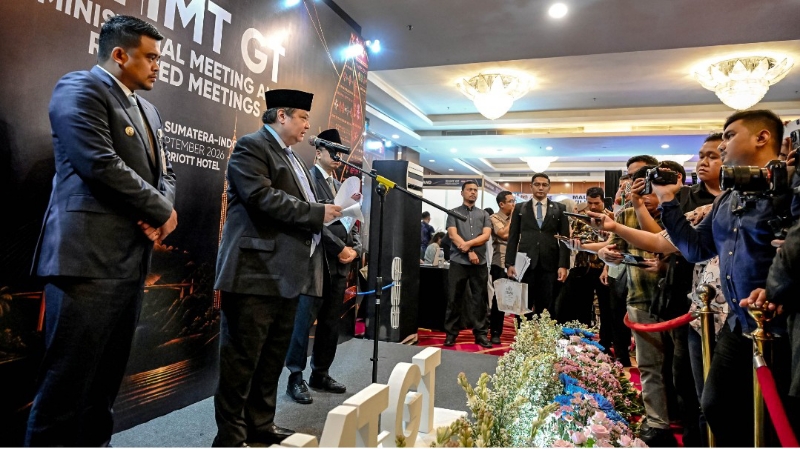
In his CMGF report, Bobby also provided an update on progress under the IMT-GT framework for sustainable urban development. The program continues to advance across several cities within the cooperation area.
According to the ASEAN Secretariat, there are 47 regional activities and 162 work activities under the ASEAN Strategic Plan for Connectivity. Meanwhile, the ASEAN Smart Cities Network continues to expand and now comprises 38 member cities.
Bobby stressed that sustainable urban development must go hand in hand with improved connectivity and stronger economic growth. For this reason, the CMGF proposed several priorities to strengthen the region's development agenda.
The first priority concerns resource mobilization along the IMT-GT economic corridors. Under this approach, states and provinces are expected to play a central role in accelerating connectivity and promoting sustainable economic growth.
The second priority focuses on integrating green concepts into the CMGF framework. This is intended to align green city policies with the Sustainable Urban Development Framework (SUDF).
The CMGF also recommended continuing the IMT-GT Green City Award as an annual program. The award is intended to recognize cities that promote green, inclusive and resilient urban development.
"Fourth, it is about strengthening the implementation of the SUDF through coordination between the national and regional levels, as well as through the Ministerial Conference on Green Cities platform. Fifth, cooperation with the Asian Development Bank (ADB) and ASEAN should be utilized to mobilize technical and financial support for corridor projects and Green City initiatives," Bobby said.
The recommendations demonstrate that IMT-GT cooperation is not focused solely on economic growth. The forum is also committed to development that takes into account environmental sustainability, regional connectivity and the resilience of cities in facing various development challenges.
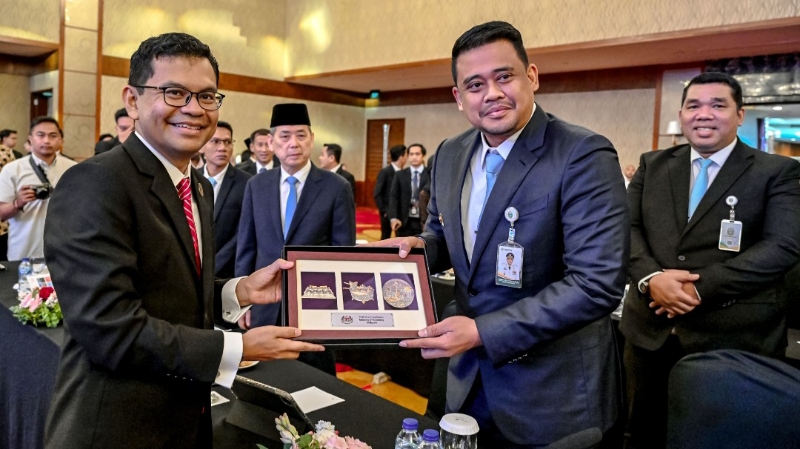
Coordinating Minister for Economic Affairs of the Republic of Indonesia Airlangga Hartarto said the IMT-GT forum could accelerate the implementation of various strategic projects across the region. According to him, Indonesia, Malaysia and Thailand have several special economic zones that could benefit from stronger cooperation.
"This is intended to accelerate the implementation of strategic projects in the region. We see, among other things, that various countries are preparing special economic zones, including Malaysia, Thailand and Indonesia. Therefore, I hope that the special economic zones in North Sumatra can also continue to grow, because they are part of the integration of cooperation in this region," Airlangga said.
Airlangga expressed hope that the special economic zones in North Sumatra could continue to be developed. In his view, strengthening these economic zones is an important component in integrating the economic potential of the three IMT-GT member countries.
Meanwhile, Malaysian Economy Minister Akmal Nasrullah said the IMT-GT forum offers additional opportunities that can be further developed through closer cooperation among the three countries.
Akmal highlighted two key areas: renewable energy and connectivity. Cooperation in the energy sector could be directed toward strengthening plans for the ASEAN Power Grid. In terms of connectivity, ongoing infrastructure projects could help further strengthen links between Thailand, Malaysia and Indonesia.
"I even joked with Minister Airlangga that it only takes one hour to travel from Kuala Lumpur to Medan, while it takes two hours to Jakarta. This shows how important it is to make the most of the geographical proximity of our countries," Akmal said.
The statement underscores the geographic advantage of the IMT-GT region. The close proximity between Sumatra, the Malay Peninsula and Thailand provides opportunities to further expand trade flows, human mobility, investment and cross-border cooperation.
From Thailand, Deputy Minister of the Office of the Prime Minister Thanadit Raktabutr expressed his appreciation to North Sumatra for hosting the meeting. He described the IMT-GT meeting in Medan as successful and emphasized the positive reception of the event.
"Thailand feels very honored to be here and is very pleased to participate in IMT-GT. We have sent 71 senior officials, including myself and the entire delegation of government representatives, to participate in this very important and successful event. On behalf of the Thai government, we are very honored to participate in the next meeting and look forward to attending next year in Malaysia. Furthermore, we will host the following meeting, as Thailand will chair ASEAN in 2028," he said.
Thanadit confirmed that Thailand would again participate in the next IMT-GT meeting in Malaysia. Thailand will also have the opportunity to host the subsequent meeting when the country assumes the ASEAN chairmanship in 2028.
The 32nd IMT-GT meeting in Medan reaffirmed the commitment of Indonesia, Malaysia and Thailand to strengthening economic integration in the region. For North Sumatra, the forum provided a strategic opportunity to showcase investment projects while expanding cooperation in industry, tourism, connectivity, energy, the creative economy and sustainable urban development.
With numerous projects on offer and a continuously expanding cooperation agenda, North Sumatra is well positioned to play a greater role as one of the key gateways for Indonesia's economic connectivity with Malaysia and Thailand. (IDNC)
REPORTER: Ahmad Zulfikar | EDITOR: Fik Sagala




 /home/u7391150/public_html/indatanews.com/theme/function.php on line 28