Tuesday, 24 November 2026
MEDAN | INDATANEWS.COM - A single click can bind an individual to dozens of contractual clauses they have never read. Consent is given within seconds, yet a legal dispute arising from that agreement may drag on for years. This paradox highlights a fundamental problem in modern contract law: can freedom of contract still reflect an equal meeting of minds when technology, capital and information are controlled by particular parties?
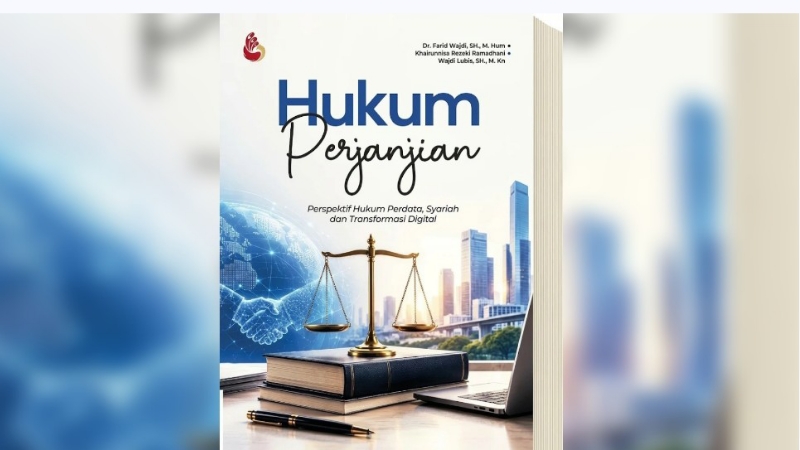
This question forms the starting point of Hukum Perjanjian: Perspektif Hukum Perdata, Syariah dan Transformasi Digital (Contract Law: Perspectives on Civil Law, Islamic Law and Digital Transformation) by Farid Wajdi and Khairunnisa Rezeki Ramadhani Wajdi Lubis. Published in 2026 by Setara Press in Malang, the book carries ISBN 978-634-7099-45-7. It comprises xvi + 214 pages and measures 15.5 × 23 centimetres.A contract may satisfy all the formal legal requirements while still containing significant imbalances. These may take the form of one-sided clauses, concealed information or dispute resolution mechanisms that disadvantage the weaker party.
From this perspective, the authors question the limits of the principle of freedom of contract. Although private autonomy remains fundamental, it cannot be separated from legal capacity, valid and informed consent, good faith and the requirement of fairness.A contract gains its social legitimacy only when its implementation ensures a balanced relationship between the parties, rather than simply benefiting the party with greater resources.
The analysis gains further depth through the dialogue between civil law and Islamic commercial law. Civil law provides legal frameworks governing obligations, contractual performance, breaches, evidence and legal remedies.The perspective of Islamic contract principles (Akad), meanwhile, introduces values such as trust, mutual consent, justice and the pursuit of the common good. At the same time, it establishes restrictions against Riba (usury or prohibited interest), Gharar (excessive uncertainty) and Maysir (gambling or speculative transactions).
This combination establishes a dual standard of assessment: a contract must be not only legally valid but also ethically defensible.The book is divided into seven chapters. Its discussion progresses systematically from philosophical foundations, terminology, legal sources and contractual principles to contract drafting, commercial practices, Islamic financial agreements, the fulfilment of obligations, the termination of contractual relationships and dispute resolution.
Its examination of renegotiation, force majeure, compensation and risk management makes the work particularly relevant to the professional practice of notaries, solicitors, regulatory authorities and business stakeholders.Technological innovation enables transactions to take place more quickly and on a wider scale. However, automation does not guarantee fairness. When algorithms execute contractual clauses without giving the parties an opportunity to raise questions or seek clarification, issues surrounding errors, liability, data security and access to effective legal remedies become increasingly important.
These issues are particularly relevant in Indonesia, where private transactions, financial services and digital commerce increasingly rely on standardised contractual terms and conditions.The book encourages readers to examine the relationship between contractual wording and social realities: Who drafts the terms and conditions? Who understands the associated risks? And who bears the consequences when contractual promises are not fulfilled?
This is where the work demonstrates its particular relevance. Rather than treating technology as a substitute for legal reasoning, the authors regard it as a test of established legal principles.Progress requires adaptable regulations without sacrificing human protection. Efficiency deserves recognition only when it does not come at the expense of people's ability to understand contractual terms, negotiate them or enforce their rights.
For students, the book connects theoretical foundations with contemporary legal challenges. For academics and practitioners, it provides an analytical framework for drafting and assessing contracts with greater care.The work also conveys a straightforward but essential message to businesses: legal certainty in transactions cannot be secured merely through stringent contractual clauses. Trust can only be sustained through agreements founded on fairness and balance.
Hukum Perjanjian is more than a guide to how legally binding agreements are formed. It encourages readers to ask fundamental questions: Who is protected by an agreement? How are risks distributed? And does digital progress genuinely deliver greater justice for everyone involved?
In doing so, the book makes an important contribution to the debate on the future of contract law. It demonstrates that technological development and legal innovation can only deliver lasting value when they do more than improve the efficiency of commercial transactions. They must also safeguard equality, legal protection and human dignity. (IDNC)BY: Dr. Farid Wajdi, S.H., M.Hum | EDITOR: Fik Sagala