Saturday, 24 October 2026
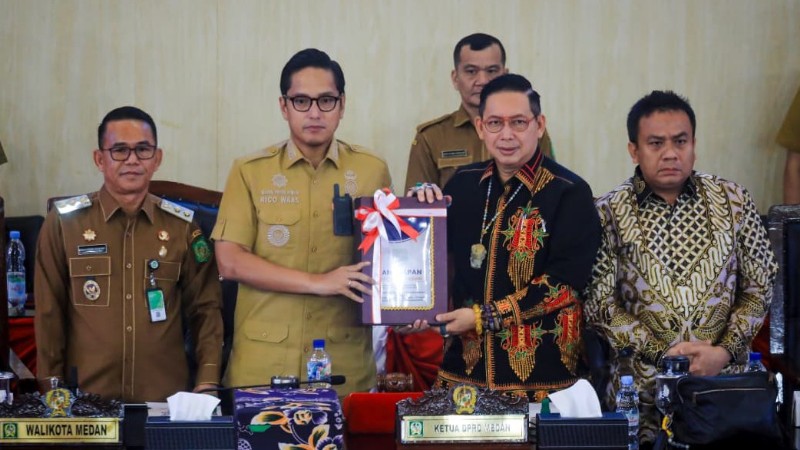
MEDAN | INDATANEWS.COM - Medan Mayor Rico Waas reaffirmed the city administration's stable and well-managed financial condition during the presentation of the municipal government's response to the general views of the Medan City Council (DPRD) factions regarding the draft regional regulation on accountability for the implementation of the 2025 Regional Revenue and Expenditure Budget (APBD).
The statement was delivered during a plenary session of the Medan City Council on Monday (June 22, 2026).
The session, held at the Medan City Council building, was chaired by Council Speaker Wong Chun Sen. Accompanying the mayor were Deputy Mayor H. Zakiyuddin Harahap, Medan Regional Secretary Wiriya Alrahman, and heads of regional government agencies.
During the meeting, Rico Waas responded to various suggestions, questions, and strategic recommendations raised by council factions. Key issues discussed included regional finances, revenue and expenditure realization, flood mitigation programs, tax system digitalization, and the continuity of essential public services.
According to the mayor, although the implementation of the 2025 budget had not fully met all expectations, major development indicators continued to record positive achievements.
"We acknowledge that the implementation of the 2025 APBD could not fulfill every expectation due to limited resources. However, we remain grateful that the city's key development indicators, particularly in the social and economic sectors, achieved the performance targets that had been set," Rico Waas told council members.
His remarks underscored that financial and human resource limitations had not prevented the city administration from maintaining development programs and public service quality.
Strong Fiscal Position Without Long-Term Debt
One of the main topics discussed during the plenary session was the city's financial condition. Responding to a question from the Gerindra Party faction, Rico Waas stated that Medan currently has no long-term debt burdening the regional budget.
The absence of long-term liabilities reflects the city's solid fiscal position despite ongoing development challenges and increasing public service demands.
In addition, Medan recorded a Budget Financing Surplus (SiLPA) of Rp592 billion for the 2025 fiscal year. According to Rico Waas, the figure remains within a healthy range and reflects effective financial management.
"The SiLPA value remains at a reasonable level. On one hand, it reflects the strong performance of regional revenues that exceeded expenditures. On the other hand, the surplus has been deliberately managed to maintain liquidity and cash availability during the first half of 2026, a period when local revenue collection is generally still limited," he explained.
He emphasized that the budget surplus should not simply be viewed as unspent funds but rather as an important instrument for safeguarding financial stability at the beginning of the following fiscal year.
Such prudent fiscal management, he added, is essential to ensure that development programs and public services continue without disruption even when revenues have not yet been fully realized.
Flood Mitigation Remains a Top Priority
Beyond financial matters, Rico Waas also addressed the decline in capital expenditure for roads, networks, and irrigation infrastructure, an issue highlighted by the PKS and Gerindra factions.
He explained that 2025 was a year of adjustment and efficiency measures. Nevertheless, the city administration continued to prioritize solutions to fundamental issues affecting residents.
The government remains committed to implementing strategic programs based on clear priorities so that residents can directly experience the benefits of development initiatives.
Flood mitigation remains one of Medan's most important priorities. The city allocated more than Rp255 billion for various flood control initiatives under three strategic programs.
"By the end of 2025, our teams had successfully resolved 1,350 flood-prone locations out of the 2,575 points identified in the city's drainage master plan. The remaining 1,225 locations will be addressed gradually," Rico Waas said.
The achievement is regarded as a significant milestone in tackling a longstanding issue that has affected Medan for years.
At the same time, the mayor acknowledged that several obstacles remain and require cross-sector collaboration, particularly river normalization efforts that fall under the authority of the Balai Besar Wilayah Sungai Sumatera II.
Because river management is under the central government's jurisdiction, the city administration cannot directly allocate APBD funds for river normalization projects. The municipality's role is limited to coordination and supporting land acquisition through joint financing schemes.
To that end, Medan continues to strengthen cooperation with relevant institutions to improve the effectiveness and sustainability of flood mitigation programs.
Digital Transformation to Strengthen Fiscal Independence
Rico Waas also highlighted the city's revenue performance. Medan's Locally Generated Revenue (PAD) reached Rp3 trillion in 2025, accounting for 48.92 percent of total regional revenue of Rp6.3 trillion.
According to him, the achievement serves as a strong foundation for enhancing the city's financial independence. However, continued innovation is needed to increase revenue collection and minimize potential losses.
As a result, the city administration is accelerating digital transformation initiatives across public services and taxation systems.
"We are expanding the use of the tapping box tax system, digitalizing waste collection payments, and exploring the implementation of Geographic Information Systems (GIS) and Business Intelligence solutions to map taxpayers more effectively," he said.
The digitalization effort is expected to improve transparency, data quality, and monitoring efficiency for potential revenue sources.
At the same time, the administration is developing a more modern and integrated system aimed at providing taxpayers with faster, easier, and more transparent services.
In budget management, Medan also implemented efficiency measures by not realizing budget allocations for food security programs under the relevant agency during the 2025 fiscal year.
Rico Waas explained that the decision followed an internal evaluation, as all related activities had already been covered under the national Free Nutritious Meals Program.
"This policy was taken deliberately to avoid overlapping expenditures, allowing regional funds to be redirected toward other urgent public needs," he said.
The measure forms part of the city government's broader strategy to ensure that every budget allocation delivers maximum benefits to residents.
The mayor further assured the public that essential services would continue to be provided optimally. The Universal Health Coverage (UHC) program remains a priority to expand access to healthcare services.
Residents can now use Medan-issued electronic identity cards to access free healthcare services outside the city, provided the healthcare facilities cooperate with BPJS Kesehatan.
In addition to healthcare, the city administration continues to improve urban infrastructure. One of its targets is to complete the underground utility cable project on 13 road corridors by 2026.
The initiative is being implemented alongside the acceleration of the National Strategic Bus Rapid Transit (BRT) Mebidang Program, which is expected to improve urban transportation services while enhancing Medan's cityscape.
"In terms of urban aesthetic infrastructure, the city government aims to free 13 road corridors from overhead utility cables by 2026 through underground installation. This initiative will run in parallel with the acceleration of the National Strategic BRT Mebidang Program," Rico Waas stated.
The plenary session marked an important moment in strengthening cooperation between the Medan City Government and the Medan City Council. Both institutions reaffirmed their commitment to transparent, accountable governance focused on improving public welfare. (IDNC)
REPORTER: Teguh Panjaitan | EDITOR: Fik Sagala