Monday, 28 September 2026
DELISERDANG | INDATANEWS.COM - The North Sumatra Provincial Government, together with district and city administrations and the Indonesian Veterinary Association (PDHI) in North Sumatra, has declared a joint commitment to make the province rabies-free by 2030. The declaration reflects a shared commitment to strengthening integrated rabies prevention and control while protecting public health and safety.
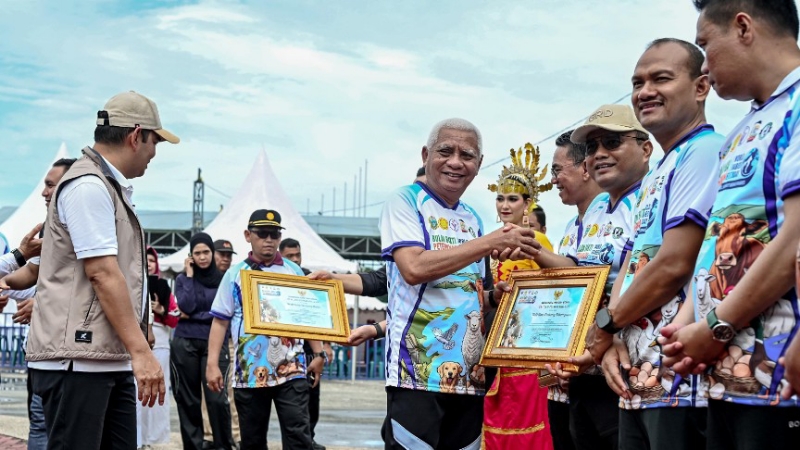
North Sumatra Deputy Governor Surya attended the declaration on Sunday, September 27, 2026, at Astaka Square on Jalan Pancing in Deli Serdang. During the event, Surya also received a certificate from the Indonesian Museum of Records (MURI) recognizing the highest number of rabies vaccinations, with a total of 15,000 doses administered.The achievement is part of the government's efforts to expand protection against animals that can transmit rabies. The North Sumatra Provincial Government, along with district and city administrations, is also urging the public to pay greater attention to the health of their pets and ensure they receive regular vaccinations.
Surya said the North Sumatra Provincial Government is committed to ensuring the availability of rabies vaccines in all districts and cities. In addition, animal health centers will be strengthened and the professional capacity of veterinary personnel will be expanded. These measures form part of the province's strategy to prevent and control rabies.
Surveillance, early detection, reporting of suspected cases, and the rapid and appropriate handling of cases will also be improved. According to Surya, these measures are necessary to establish a prevention system capable of responding quickly to potential rabies outbreaks."The North Sumatra Provincial Government is committed to ensuring the availability of rabies vaccines in all districts and cities, strengthening animal health centers, expanding the capacity of veterinary personnel, and improving surveillance, early detection, reporting, and the rapid and appropriate handling of cases," Surya said.
Surya said North Sumatra recorded 280 rabies cases in 2025. The figure demonstrates that rabies is not solely an animal health issue but also concerns the protection and safety of the public.The government therefore continues to prioritize preventive measures through animal vaccination and the development of professional capacity among animal health personnel. These measures must be accompanied by greater public awareness so that pet owners understand the importance of vaccination and know what steps to take when animals display symptoms that may indicate rabies.

Surya emphasized that the goal of making North Sumatra rabies-free by 2030 cannot be achieved if responsibility rests with a single institution. He therefore called on all district and city governments, professional organizations, universities, businesses, communities, and the public to participate in rabies prevention and control efforts.
He said all stakeholders need to adopt the One Health approach, which connects the health of humans, animals, and the environment. The approach highlights the importance of collaboration, as rabies cannot be addressed solely from an animal health perspective.Coordination in surveillance and early detection must also continue to be improved. When members of the public identify signs of a suspected case, the information should be reported immediately so that the relevant response teams can take the necessary measures to prevent further transmission of the disease.
Alongside strengthening the animal health system, public education is another important component of efforts to achieve the 2030 target. The public needs to understand that regular vaccination of pets is among the most important measures for reducing the risk of rabies transmission.On the occasion, Surya also urged residents to pay greater attention to the health of their pets. Public participation plays an important role in breaking the chain of rabies transmission.
"I also urge the entire community to have their pets vaccinated regularly. Public awareness is the key to breaking the chain of rabies transmission," he said.
Nuryani stressed that even a single rabies case can have a significant impact on an affected family. Prevention must therefore be prioritized. This includes expanding animal vaccination, increasing public awareness, and ensuring rapid treatment when people have been exposed to the virus.
"Behind every single rabies case is a concerned family, parents hoping their child can be saved, and a life that could be lost to a disease that can actually be prevented," she said.North Sumatra's declaration to become rabies-free by 2030 encompasses a number of joint commitments. The government and all relevant stakeholders aim to strengthen integrated rabies prevention and control, ensure the availability of vaccines in all districts and cities, and further expand surveillance and early detection.
The measures also include public education and stronger cross-sectoral cooperation under the One Health approach. Government institutions, veterinary personnel, professional organizations, universities, businesses, communities, and the public are expected to continuously carry out their respective roles.The vaccination of 15,000 animals, which also contributed to North Sumatra receiving a MURI certificate, represents a concrete measure to expand protection against rabies. However, the government continues to rely on public participation to ensure regular animal vaccinations and expand coverage to more areas.
Through the declaration, North Sumatra has set a target of strengthening integrated rabies control efforts by 2030. Expanding vaccination programs, animal health services, surveillance, early detection, reporting systems, public education, and cross-sectoral cooperation are key components of efforts to achieve the goal of making the entire province of North Sumatra rabies-free. (IDNC)REPORTER: Ahmad Zulfikar | EDITOR: Fik Sagala





 /home/u7391150/public_html/indatanews.com/theme/function.php on line 28