Sunday, 01 November 2026

The Deli Serdang Regency Government held the reflection forum on Tuesday, August 18, 2026, at the Cadika Hall in Lubuk Pakam. The forum brought together regional government representatives, academics, activists, students and media practitioners to examine Deli Serdang's development from different perspectives.
Regent Asri Ludin Tambunan said the reflection forum was intended to gather input that had not yet been captured through the government's ongoing collection of public concerns under the Berjemur program. The proposals received will serve as a basis for preparing the draft regional budget (RAPBD) and shaping regional development policies."This reflection is being held to gather input that I have not received so far. We have visited various areas to hear people's concerns directly. Alhamdulillah, these suggestions have now become part of the budget planning and existing policy measures," Asri Ludin said.
During the first 1.5 years of his administration with Lom Lom Suwondo, the Deli Serdang Government has focused its development policies on several strategic areas, including health, education, the economy, infrastructure and governance.In the health sector, coverage of the PAS JEMPOL program reached 80.75 percent, while Universal Health Coverage (UHC) stood at 98.70 percent as of July 2026. In the economic sector, realized investment reached approximately Rp3.62 trillion.
The Deli Serdang Government also recorded a 95.2 percent rate in handling public complaints submitted through the LAPOR application in 2026. In addition, access to public services has been expanded through PATEN KALI, which covers 22 subdistricts and 205 villages and urban wards.Asri Ludin stressed that the government was not focused solely on figures and target achievement, but continued to address concrete problems faced by residents in accessing public services and development programs.
"My intention is simple: what has been a problem should no longer remain a problem," he emphasized.According to Agus Riadi, the government needs to strengthen public communication so that its various development achievements become more widely known. At the same time, he encouraged greater public participation and urged the government to make stronger use of social media as a communication channel between the government and the public.
"When we look at Deli Serdang's development, there are several areas where progress has been made, starting from public services, human resource development and social affairs to strengthening the local economy, as well as infrastructure and regional development. Going forward, these achievements must continue to be communicated to the public so that people know what the government has implemented while also having an opportunity to provide feedback," he said.Agus Purwoko, a lecturer in the Regional Development Planning master's program at USU, also highlighted the importance of connectivity for Deli Serdang's economic growth. In his view, the regency's strategic location is a major asset for attracting investment and stimulating economic activity among residents.
"Deli Serdang has a very strategic location. Therefore, connectivity is crucial for capturing investment flows and economic activity. The better the connectivity we create, the greater Deli Serdang's opportunities to attract capital inflows and stimulate the people's economy," he explained.Agus Purwoko emphasized that the government needs to understand the concept of connectivity more broadly. Development should not rely solely on physical infrastructure, but must also expand digital connectivity and make it easier for people to access bureaucratic services.
"Connectivity therefore does not only mean focusing on physical space, but also mastering the digital space. If bureaucratic services become easier and are accessible digitally, people will no longer feel that they have to live in or travel to Medan to handle certain matters," he said.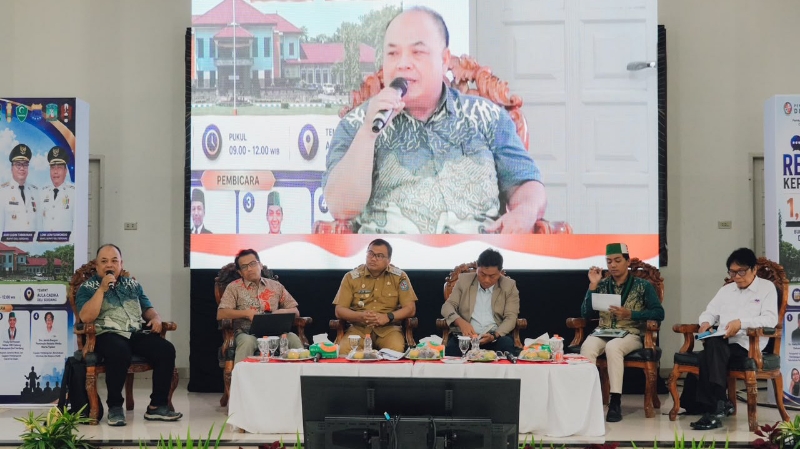
Chairman of the Deli Serdang HMI branch, Fredi Mawan, conveyed a number of concerns raised by the younger generation. These included education, the creative economy, tourism, sports and youth participation in development planning.
Fredi welcomed the government's move to create dialogue spaces for students and youth organizations. In his view, such forums can serve as a bridge through which the needs of the younger generation can be conveyed directly to the regional government."I would like to express my appreciation and gratitude to the Regent and his team. The Regent's policies as the head of the region show that young people are receiving attention. Hopefully, spaces like this will continue to be opened in the future," he said.
He also called on the Deli Serdang Government to provide greater opportunities for young people to participate in determining the direction of development. Among his proposals was the organization of a thematic Musrenbang for youth involving youth organizations, student organizations and existing student executive bodies (BEM) in Deli Serdang."We hope there will be a thematic Musrenbang for youth. All youth organizations, student organizations and BEMs in Deli Serdang should be involved so that the aspirations of young people are truly incorporated into development planning," Fredi said.
Meanwhile, veteran journalist Jenda Bangun, who also serves as editor-in-chief of Warta Tipikor, said the development achievements presented by the Deli Serdang Government deserved to be communicated to the public. At the same time, he urged the government to further improve transparency and provide journalists with easier access to data.According to Jenda, an open data policy would help the media deliver complete and verified information about development to the public.
"The programs that have already been achieved deserve to be published, updated and reported by us. However, whenever journalists ask for data, we hope the information can be explained. That way, we can obtain complete information, while the public also receives accurate information," he said.Jenda also urged the regional government to further strengthen communication with the media. Open communication, he said, would help the media carry out its information function while expanding the dissemination of information about government programs and development achievements among the public.

"I thank the activists, students, academics and media representatives who presented their criticism and suggestions today. For us, this is part of democracy and at the same time an encouragement for me and the Regent to continuously pursue the improvements needed in Deli Serdang's development," he said.
Lom Lom appreciated the dialogue space created through the reflection on the first 1.5 years of the administration. In his view, differences of opinion should not create distance between the government and the public. Instead, different perspectives can become a driving force for improving areas where further action is still needed."We are not allergic to criticism. On the contrary, criticism and suggestions help us identify what may not yet be optimal and what needs to be improved in the future. Let us build Deli Serdang together," he said.
Lom Lom also stressed that the various achievements recorded over the past 1.5 years were not a reason for the government to rest on its laurels. Therefore, the government will continue to gather public concerns and use them as a basis for evaluating and improving its policies.Asri Ludin added that the government would follow up on several suggestions raised during the forum in accordance with the authority and capacity of the regional government. These included strengthening communication with the media and students, increasing transparency in information and expanding youth participation in development planning.
"We will hold these meetings regularly, both with the media and with students. We will also prepare a thematic Musrenbang for youth so that we can listen to the needs and concerns of the younger generation and incorporate them into development planning," he concluded.Through the reflection forum, the Deli Serdang Government not only presented the achievements of the first 1.5 years of its administration, but also opened a space for joint evaluation. The government hopes that input from academics, students, activists, youth and the media will help strengthen its policies and ensure that Deli Serdang's development increasingly meets the needs of its people. (IDNC)
REPORTER: Edi Saputra | EDITOR: Fik Sagala