Friday, 23 October 2026

LABUHANBATU SELATAN | INDATANEWS.COM - Fery Sahputra Simatupang, Regent of Labuhanbatu Selatan, led the commemoration of the 12th National Santri Day on Thursday, 22 October 2026, at Santun Berkata Bijak Berkarya (SBBK) Square in Kotapinang District.
During the ceremony, Fery read out a message from Indonesia's Minister of Religious Affairs under this year's theme, "Strengthening the Nation through Santri on the Path towards a Golden Indonesia". The message highlighted the important role of santri in developing high-quality human resources, with particular emphasis on scientific and technological knowledge, character development and service to society.This year's commemoration aims to encourage santri to extend their contributions beyond religious activities. They are expected to play a greater role in education, science, technology, entrepreneurship and leadership, helping to address the country's evolving challenges.
The Minister of Religious Affairs' message called on santri to continue developing their skills and adapting to social change while preserving their moral values and the traditions of Islamic boarding schools, known as pesantren.
The expression man jadda wajada, which broadly means that those who strive earnestly will succeed, underscores the importance of hard work, perseverance and a willingness to innovate. These qualities are considered essential to building a better future.Santri are also expected to apply the knowledge they acquire at pesantren for the benefit of society. Religious education, therefore, should go hand in hand with a broader understanding of science and technology. This combination can help prepare them to contribute to solutions for the various challenges facing social and economic development.
Pesantren fulfil three main functions: education, religious outreach and the promotion of community participation. Together, these roles help shape a generation that is knowledgeable, morally grounded, independent and committed to social responsibility.The minister's message also highlighted the establishment of a Directorate General for Pesantren within Indonesia's Ministry of Religious Affairs under President Prabowo Subianto. The move was presented as evidence of the government's commitment to developing and strengthening Islamic boarding schools.
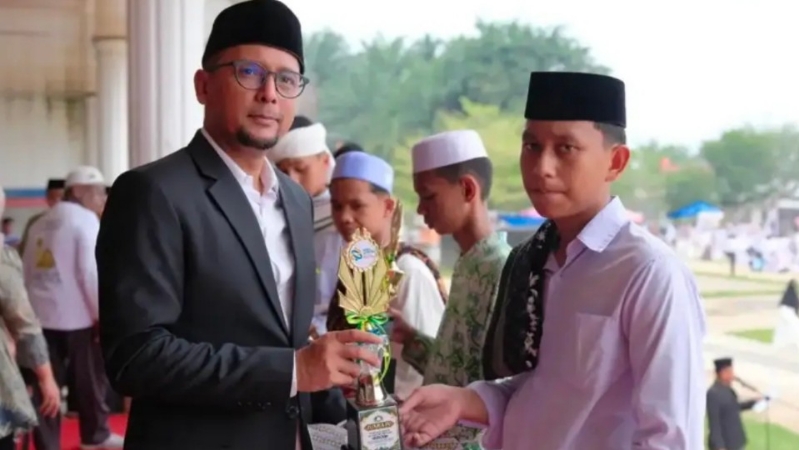
Other attendees included the head of the local office of the Ministry of Religious Affairs, the chairman of the Indonesian Ulema Council, religious leaders, pesantren founders, Islamic religious teachers, former santri and other invited guests.
During the ceremony, a flag party raised Indonesia's red-and-white national flag. The moment paid tribute to the contributions of Islamic scholars, santri and national heroes in the struggle to defend Indonesia's independence.National Santri Day is observed annually on 22 October. It commemorates the Jihad Resolution proclaimed by Hadratus Sheikh Kiai Haji Hasyim Asy'ari on 22 October 1945. The declaration mobilised Muslims to defend Indonesia's independence and became an important part of the country's national liberation history.
The resolution preceded the fighting of 10 November 1945, which Indonesia commemorates each year as Heroes' Day.
As Indonesia pursues its vision of becoming a Golden Indonesia by 2045, santri are expected to take greater responsibility for regional and national development. Their contributions may include advancing science and technology, developing innovative solutions, strengthening economic independence and raising awareness of environmental protection.
The principle hubbul wathan minal iman, commonly understood as meaning that love of the homeland is part of faith, also reinforces the importance of social cohesion and national unity.The commemoration in Labuhanbatu Selatan reaffirmed the role of pesantren in preparing a generation equipped with knowledge, integrity and strong moral values. Santri are expected to put their education into practice for the benefit of their communities and contribute actively to Indonesia's long-term progress. (IDNC)
REPORTER: Jhon Fitra Sagala | EDITOR: Fik Sagala