Wednesday, 16 September 2026
BERINGIN | INDATANEWS.COM - Farmers in Beringin District, Deli Serdang Regency, are continuing to expand red chili cultivation in an effort to increase production while ensuring supply amid a recent surge in chili prices in the market. The Deli Serdang Regency Government is supporting the initiative through agricultural inputs, market interventions and improved access to marketing opportunities for farmers.
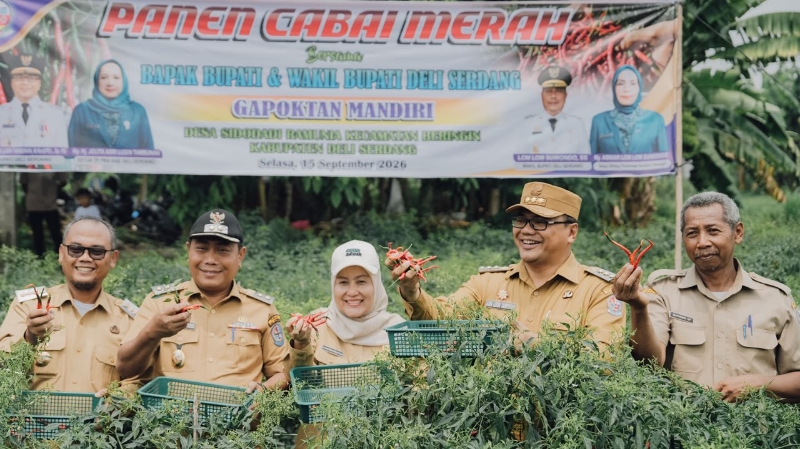
Chairman of the Gapoktan Mandiri Farmers Association, Sugiarto, reported on the development to the Regent and Deputy Regent of Deli Serdang after taking part in a joint red chili harvest in Kauman Hamlet, Sidodadi Ramunia Village, Beringin District, on Tuesday, September 15, 2026.
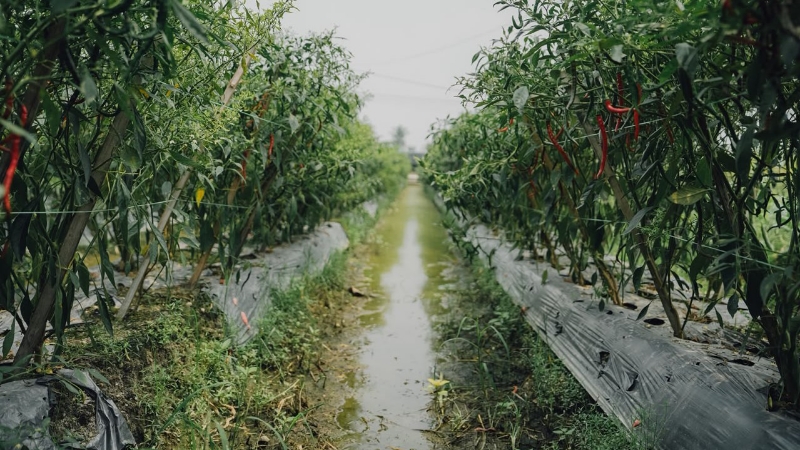
Sugiarto said Gapoktan Mandiri currently comprises 11 farmer groups. All 11 groups have now begun cultivating red chili. This, he said, reflects growing interest among farmers in an agricultural commodity with relatively high economic value.
Previously, Sugiarto explained, only five groups were actively cultivating chili. With the support and assistance they have received, however, all groups have gradually started planting chili, resulting in a continuous expansion of cultivated land.
The growing agricultural activity has also had a positive impact on the financial condition of the farmer groups, according to Sugiarto. More structured planning and management of cultivated areas are giving farmers greater opportunities to increase production and, consequently, their incomes.
In addition to expanding cultivated areas, farmers in Beringin District are also beginning to coordinate their planting cycles. The goal is to ensure production continuity while making it easier to control pests, which are often among the biggest challenges in chili cultivation.
Sugiarto said farmers now hold joint consultations before determining when planting will begin. Through this agreement, farmer groups can coordinate their planting schedules so that not all cultivated areas are planted at the same time.
"This is also thanks to the Regent. We now hold consultations before planting and agree together on when to begin. With an organized planting schedule, pest control will also be easier, and harvesting can take place continuously," he said.
A more structured planting schedule also enables farmers to maintain a continuous supply. While some fields are already being harvested, other fields can enter the harvesting stage at a later time. In this way, chili production can be maintained continuously rather than depending solely on a single harvest period.
Deli Serdang Regent dr. H. Asri Ludin Tambunan praised the expansion of chili cultivation carried out by farmers in Beringin. In his view, increased food production must be accompanied by appropriate government support so that farmers can optimize their productivity.
The Deli Serdang Regency Government will continue to provide support based on the farmers' needs, he said. Such assistance includes the provision of agricultural equipment and machinery, as well as various measures aimed at increasing production.
"In principle, the government will support the needs of farmers so they can maximize their yields, maintain the stability of agricultural commodities and, at the same time, strengthen food supplies," he said.
The support is part of the government's efforts to maintain a balance between farmers' interests and the needs of the public. On one hand, higher production is expected to help increase farmers' incomes. On the other hand, adequate supplies can help limit sharp price fluctuations in the market.
The Deli Serdang Government is also taking measures to respond to currently high chili prices. One of the measures involves the Toko Pengendali dan Pantau Inflasi (TOPPIS), or Inflation Control and Monitoring Stores, which have been established at six traditional market locations.
In addition, the government is holding low-cost market operations as part of its strategy to protect public purchasing power. The initiative is intended to provide residents with an alternative when the prices of various staple food commodities, including chilies, rise.
Notably, the government does not view farmers solely as beneficiaries of the program. The Deli Serdang Government is also involving local farmers as suppliers of chilies for the TOPPIS outlets. This enables the market intervention to simultaneously create additional marketing opportunities for locally produced agricultural commodities.
The model shortens the link between farmers' production and public demand. Farmers gain an additional marketing channel, while residents can obtain chilies through government-operated outlets as part of efforts to stabilize prices.
To ensure that as many people as possible benefit from the program, the government has also limited the quantity of chilies that can be purchased at TOPPIS outlets. Each family is allowed to purchase a maximum of one kilogram of chilies.
"Purchases of chilies at TOPPIS are limited to a maximum of one kilogram per family so that as many people as possible can benefit from the market intervention," he explained.
In addition to market interventions, the Deli Serdang Government also plans to strengthen cooperation with other regions. This is considered important to ensure a continuous supply of chilies, particularly when local production declines due to seasonal factors or agricultural conditions.
Interregional cooperation is expected to strengthen the supply network while enabling the government to respond more quickly to price changes. With supplies secured, the government will have greater room to maneuver in maintaining price stability for the public.
Deputy Regent of Deli Serdang Lom Lom Suwondo emphasized that increased chili production should not be measured solely by larger cultivated areas and higher harvest volumes. The government must also ensure that increased production has a tangible impact on farmers' welfare.
For this reason, the Deli Serdang Government will monitor farmers' economic development using several indicators. These include the growth of savings, QRIS usage and community activity in accessing banking services.
According to Lom Lom, these indicators can provide an overview of how farmers' economic conditions are developing after engaging in agricultural activities and earning income from their production.
"Essentially, we will measure the economic condition of the community and farmers. The indicators include increased savings, QRIS usage and other instruments related to banking services," he said.
This approach demonstrates that the government does not regard increased agricultural production as the sole measure of success in the agricultural sector. Instead, it aims to ensure that growing economic activity in agriculture ultimately leads to improved economic conditions for farming households.
The expansion of chili cultivation in Beringin is therefore part of a broader strategy. Farmers are increasing production through expanded cultivated areas and coordinated planting schedules, while the government is providing agricultural inputs, expanding market access and implementing measures to stabilize prices.
Amid currently high chili prices, increased production from local agricultural centers is an important step toward strengthening product availability. If supply increases and distribution runs smoothly, market price pressures are expected to ease.
At the same time, the government must ensure that the prices received by farmers continue to provide an adequate profit margin. Maintaining a balance between farm-gate prices and the prices paid by consumers is one of the key challenges in stabilizing food prices.
Through expanded cultivation, coordinated production schedules, pest control, marketing through TOPPIS, low-cost market operations and cooperation with other regions, the Deli Serdang Government is working to build a system that both secures supplies and creates economic benefits for farmers and the wider community.
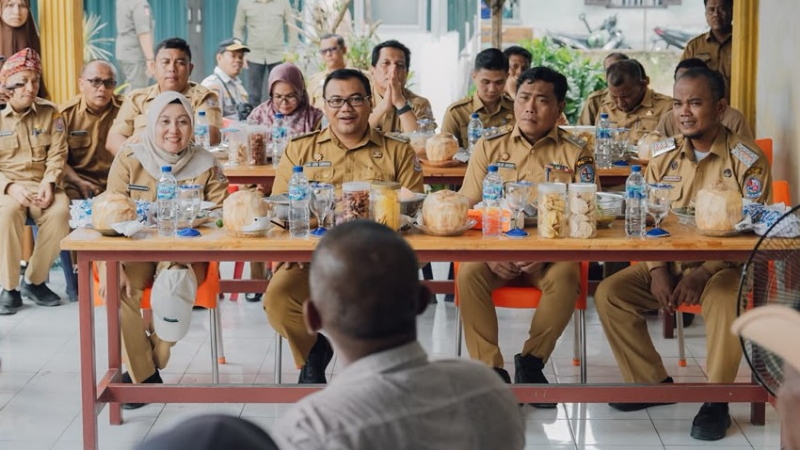
The joint red chili harvest in Kauman Hamlet, Sidodadi Ramunia Village, also provided an opportunity to further strengthen cooperation between the regional government and farmer groups. Representatives of regional agencies, the director of the regional-owned enterprise (BUMD) Bhinneka Perkasa Jaya and representatives of farmer groups also attended the event.
This cooperation is expected to continue so that the development of chili cultivation can not only respond to short-term market demand, but also strengthen the region's long-term food security and sustainably improve the welfare of farmers in Deli Serdang. (IDNC)
REPORTER: Edi Saputra | EDITOR: Fik Sagala






 /home/u7391150/public_html/indatanews.com/theme/function.php on line 28