Thursday, 03 September 2026
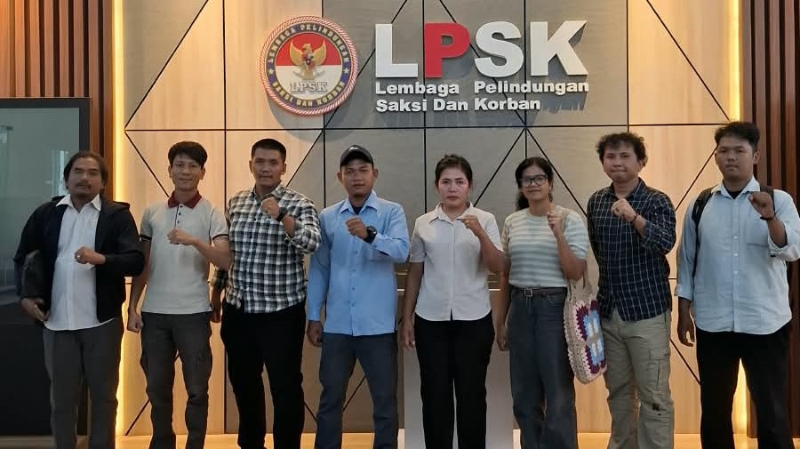
JAKARTA | INDATANEWS.COM - The Rakyat Melawan Impunitas (ARMI) Advocacy Team, together with Desi Natalia Nainggolan, the wife of Luis David Hutabarat, on Tuesday, September 1, 2026, filed reports and complaints with several state institutions over allegations of planned murder and torture. Members of the Indonesian Military (TNI) and security personnel from PT Agrinas Palma Nusantara are alleged to have been involved in the case.
The complaints were submitted directly to the National Human Rights Commission of Indonesia (Komnas HAM), the National Commission on Violence Against Women (Komnas Perempuan), the Indonesian Child Protection Commission (KPAI), the Ombudsman of the Republic of Indonesia, and the National Police Commission (Kompolnas).In addition to the death of Luis David Hutabarat, ARMI also raised allegations of torture against Doni, Tomi and Jhoni. The advocacy team believes the case involves not only potential criminal offenses but also serious human rights concerns.
Richard S.D. Hutapea, SH, of the Legal Aid Foundation (LBH) Medan Advocacy Team, emphasized that ARMI is examining the case from both criminal law and human rights perspectives.
According to Richard, Luis David's death is directly linked to an alleged violation of the right to life. The violence allegedly inflicted on the other victims must also be investigated in light of the prohibition against torture and cruel, inhuman or degrading treatment or punishment."This complaint is an effort to ensure that the events leading to Luis David's death and the injuries suffered by the other victims do not end with an investigation limited to those who directly carried out the acts," Richard said in an official statement received on Tuesday, September 1, 2026.
Richard said ARMI is calling on the relevant authorities and institutions to conduct a comprehensive investigation into the entire sequence of events. The investigation, he said, must examine the motive, the manner in which the violence was carried out, possible planning, and the possible involvement of other individuals in the incident."The death of Luis David constitutes a serious violation of the right to life, which is among the fundamental rights that may not be restricted under any circumstances," Richard said.
Richard subsequently referred to Article 28A of the 1945 Constitution of Indonesia in conjunction with Article 6 of the International Covenant on Civil and Political Rights (ICCPR), which guarantees every person's right to life. He also noted that the UN Human Rights Committee regards the right to life as the supreme right and the foundation for the realization of other rights.Indonesia acceded to the ICCPR through Law No. 12 of 2005. Through this commitment, the state is obligated to respect, protect and guarantee every person's right to life. This includes preventing arbitrary killings and conducting effective investigations when a person dies under unusual circumstances.
Protection of the right to life is also enshrined in Law No. 39 of 1999 on Human Rights."Therefore, Luis David's death must not simply be treated as the result of an ordinary criminal offense. The state is obligated to fully investigate the case and ensure that the cause of death, the sequence of violence preceding his death, and all parties responsible are established through an independent and transparent investigation," Richard said.

Adinda said Article 7 of the ICCPR expressly prohibits torture and cruel, inhuman or degrading treatment or punishment.
"The UN Human Rights Committee has reaffirmed that this prohibition protects the dignity and physical and mental integrity of every person and requires the state to provide appropriate protection through legal and other measures," she said.According to Adinda, Indonesia also ratified the Convention Against Torture and Other Cruel, Inhuman or Degrading Treatment or Punishment (CAT) through Law No. 5 of 1998. The ratification creates international obligations for Indonesia to prevent torture, investigate allegations of torture and ensure that those responsible are held accountable.
She also referred to Law No. 39 of 1999 on Human Rights, which defines torture as an intentional act that, under circumstances specified by law, causes severe physical or mental pain or suffering.These provisions also cover acts committed by public officials or at their instigation, with their consent or with their knowledge.
In addition, Law No. 1 of 2023 on the Indonesian Criminal Code (KUHP) regulates torture as a separate criminal offense. The explanatory provisions of the Criminal Code identify Article 530 as the provision concerning the crime of torture and link it to Indonesia's obligations under the Convention Against Torture."Therefore, the allegations of torture against Luis David, Doni, Tomi and Jhoni must be investigated separately and must not be subsumed into an ordinary assault case," Adinda Zahra said.
ARMI considers the allegations of planned murder and torture particularly serious because they involve two fundamental human rights: the right to life and the right to be free from torture. Both rights are protected under Indonesian law as well as international human rights instruments to which Indonesia is bound.
ARMI emphasized that the victims and their families have the right to truth, justice and reparations. According to the advocacy team, the reparations process must take into account the physical, psychological, social and economic impacts resulting from the incident.
On this basis, ARMI has issued several demands to the relevant state institutions.First, ARMI called on Komnas HAM to monitor and thoroughly investigate the allegations of human rights violations, particularly those concerning the right to life and alleged torture in the case.
Second, ARMI called on Kompolnas to monitor the investigation and inquiry conducted by the Labuhanbatu Police and ensure that the process is carried out independently, professionally, transparently and accountably.Third, ARMI called on Komnas Perempuan to pay particular attention to the impact of the case on women and the families of the victims. The commission was also urged to ensure that the handling of the case takes a victim-centered approach.
Fourth, ARMI called on the Witness and Victim Protection Agency (LPSK) to immediately protect Doni, Tomi, Jhoni, Luis David's family and all witnesses. The protection should cover potential threats, intimidation, pressure and possible criminalization.Fifth, ARMI called on the Ombudsman of the Republic of Indonesia to investigate allegations of maladministration or failures by government authorities to fulfill their duties in the case.
Sixth, ARMI called on all parties to ensure that Luis David's family receives its rights to truth, justice, reparations and guarantees of non-recurrence.Through the complaints, ARMI hopes that the state institutions will carry out their respective oversight and protection functions in accordance with their mandates. The advocacy team also called for the legal process not to focus solely on those directly involved at the scene, but to uncover the entire chain of events and identify all individuals connected to the alleged acts of violence and Luis David's death.
ARMI believes that a comprehensive investigation into the facts is crucial to ensuring justice for the victim's family while preventing similar alleged human rights violations from occurring again in the future. (IDNC)REPORTER: Darmailawati | EDITOR: Fik Sagala





 /home/u7391150/public_html/indatanews.com/theme/function.php on line 28