Wednesday, 04 November 2026
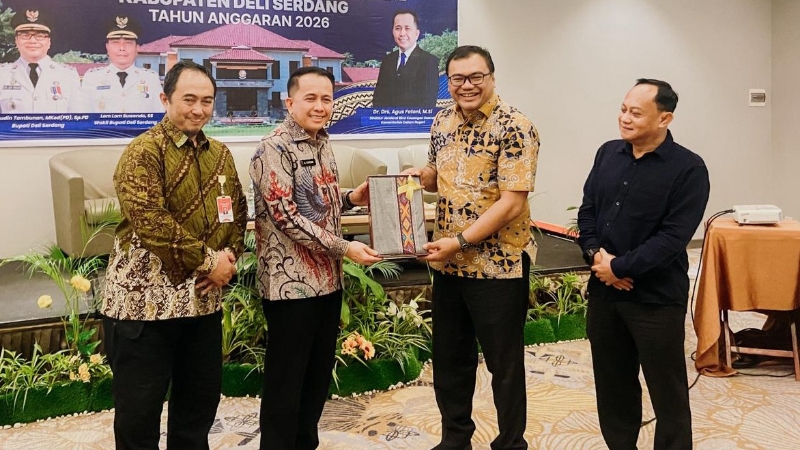
DELI SERDANG | INDATANEWS.COM - Deli Serdang Regent Asri Ludin Tambunan has asked the central government for guidance to strengthen the alignment of regional development programs with strategic national programs. He made the request while attending a Focus Group Discussion (FGD) on strengthening regional policies to achieve national program targets in Deli Serdang Regency for the 2026 fiscal year. The event was held on Sunday evening, August 30, 2026, at the Wing Hotel Kualanamu in Batang Kuis District.
The forum was attended by representatives of the Deli Serdang Regency Government and the Indonesian Ministry of Home Affairs. The discussion focused on efforts to strengthen regional policies in support of national program targets. Among those present were the Ministry of Home Affairs' Director General of Regional Finance, Agus Fatoni; Director of Regional Revenue, Teguh Narutomo; Deli Serdang Regional Secretary Dedi Maswardy; heads of various regional agencies; and other invited guests.
The regent described the meeting as an important opportunity for the Deli Serdang Government to receive direct input from the central government, particularly in determining a development direction that remains aligned with national policies.
Asri Ludin said Deli Serdang holds a strategic position because of its geographical location. The regency borders Medan and also surrounds the city, which serves as the capital of North Sumatra Province. This geographical position, along with an area of approximately 2,400 square kilometers and a large population, gives Deli Serdang significant potential to support economic growth in North Sumatra, he said.
This potential can be developed through various strategies, including the development of new urban areas and satellite cities. The development of these areas is expected to strengthen economic connectivity while creating new growth centers outside Medan's urban core.
Deli Serdang currently also plays an important role in North Sumatra's economy. The regency is the province's second-largest contributor to gross regional domestic product (GRDP), after Medan.
Asri Ludin welcomed the presence of Ministry of Home Affairs representatives at the FGD. The participation of the central government, he said, was an important moment for the regional government to strengthen coordination while receiving input on development policies.
"Although today is a holiday and it is already evening, we have welcomed very special guests. The presence of the Director General and the Director demonstrates the central government's attention to Deli Serdang Regency," he said.
The regent hopes this attention will develop into even stronger cooperation between the central government and the Deli Serdang Government. Such synergy is needed to accelerate development while addressing various social and economic challenges that residents continue to face.
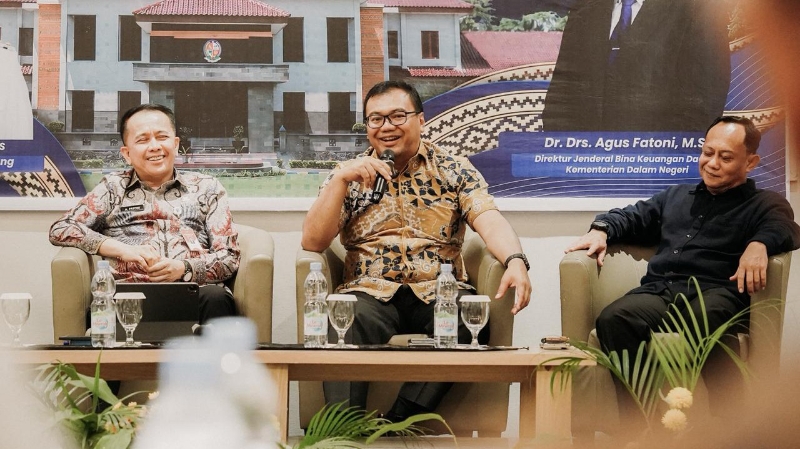
The Deli Serdang Government continues to work to boost regional economic growth while reducing poverty and unemployment. According to Asri Ludin, the poverty rate in Deli Serdang currently stands at around 3.11 percent, while the open unemployment rate is 7.69 percent.
These figures are among the indicators that must be taken into consideration in formulating and implementing regional development policies. The regional government must ensure that economic growth is not reflected merely in increased economic activity, but also produces a tangible impact on people's welfare.
The regent hopes the FGD with Ministry of Home Affairs representatives will produce concrete guidance capable of strengthening Deli Serdang's development policies for the 2026 fiscal year. The recommendations are expected to help the regional government ensure that planned programs are implemented more effectively and contribute to national development goals.
"Through this FGD, we hope the central government's guidance can strengthen the alignment of regional development programs with national policies, so that the programs already planned can be implemented more effectively and development can continue to accelerate," he said.
To support this effort, Asri Ludin said the Deli Serdang Government would continue working to establish a common understanding and shared vision among all regional agencies. This common direction is important so that each agency can implement its programs in a coordinated manner while supporting strategic national programs.
The aim is to ensure that development does not take place in isolation within individual regional agencies, but is instead interconnected in order to achieve the development targets established by both the regional and central governments.

The Ministry of Home Affairs' Director General of Regional Finance, Agus Fatoni, praised the commitment of the regent and Deli Serdang Government officials who took part in the discussion despite it being a holiday and the event being held late in the evening.
"If the regent remains this committed on a holiday and at such a late hour, it is a sign that Deli Serdang will continue moving forward and maintaining its commitment," he said.
Agus emphasized that the success of regional development does not depend solely on the size of a budget. Regional governments must instead manage their budgets effectively, efficiently and properly, while placing public benefit at the center of their spending decisions.
In his view, the regional government must ensure that all stages of regional financial management are clearly interconnected. Planning must serve as the basis for budget preparation, the budget must support program implementation, and the results of implementation must subsequently be properly accounted for.
"What is planned is budgeted, what is budgeted is implemented, and what is implemented must be accounted for. Everything must be aligned," he said.
Agus also urged the Deli Serdang Government to optimize its locally generated revenue (PAD), particularly amid challenges involving transfers to regional governments. The regional government can increase PAD through intensification, expanding revenue sources, strengthening oversight, and improving the quality of human resources.
He said Deli Serdang has substantial regional potential and therefore must make optimal use of its resources. Harnessing this potential must go hand in hand with improving the capabilities of government personnel in order to create better policies and public services.
In addition to revenue management, Agus highlighted the importance of the competence of government personnel and the quality of leadership in determining the performance of regional government organizations.
"Human resources will determine everything. The core of organization and management is leadership," he said.
Agus also called on the Deli Serdang Government to continue building a culture of creativity and innovation. In his view, the regional government must have the courage to reassess existing working methods if it wants to achieve better development outcomes.
He stressed that changing development outcomes requires the courage to develop new approaches, particularly in the face of increasingly complex regional development challenges.
"If we want different results, we must take different approaches. Deli Serdang will not move forward and make a leap if the old methods remain unchanged," he concluded.
The FGD was part of efforts to strengthen coordination between the Deli Serdang Regency Government and the central government. Through better policy alignment, more effective budget management, optimization of locally generated revenue, and improvements in the quality of government personnel and leadership, Deli Serdang is expected to achieve its regional development targets more quickly while making a greater contribution to the implementation of national programs. (IDNC)
REPORTER: Edi Saputra | EDITOR: Fik Sagala