Friday, 23 October 2026

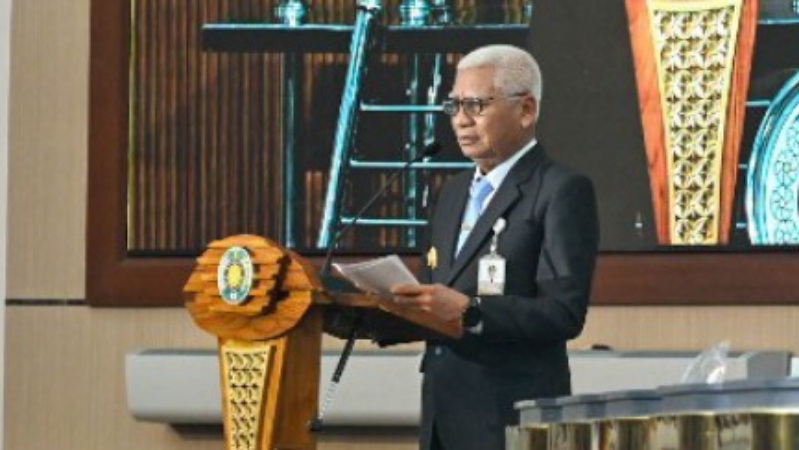
MEDAN | INDATANEWS.COM - North Sumatra Deputy Governor Surya has praised the contribution of Universitas Sumatera Utara (USU) to advancing education, research, community engagement and regional development. He said USU plays a strategic role in improving the quality of human resources, producing outstanding research, empowering communities and strengthening policy alignment with the government.
Surya made the remarks during the public session commemorating the 74th anniversary of Universitas Sumatera Utara at the USU Auditorium on Jalan Dr. Mansyur in Medan on Thursday, August 20, 2026. The event was attended by, among others, Chairman of the USU Board of Trustees (Majelis Wali Amanat/MWA) and Minister of Immigration and Corrections Agus Andrianto, Minister of Micro, Small and Medium Enterprises (UMKM) Maman Abdurrahman, members of the North Sumatra Regional Leadership Coordination Forum (Forkopimda), members of the House of Representatives (DPR RI), professors, university rectors, several regents and mayors, as well as members of the USU academic community.On the occasion, Surya said the theme of USU's 74th Dies Natalis, "Listening to Science for Global Impact," was highly relevant to current development challenges. He said the theme underscored the importance of science as a foundation for understanding problems while also guiding the direction of policy decisions.
Surya said universities hold an important position in producing knowledge that can help the government address various problems facing society. In his view, research, innovation, interdisciplinary collaboration and evidence-based policymaking must go hand in hand so that scientific knowledge can provide benefits not only locally but also contribute at the global level.
"The importance of research, innovation, interdisciplinary collaboration and evidence-based policy lies in ensuring that scientific knowledge is not only useful locally but can also contribute at the global level. For the North Sumatra Provincial Government, universities are strategic partners in development," he said.According to Surya, research findings offer significant opportunities to be transformed by the government and other stakeholders into concrete solutions. Research can generate innovations, policy recommendations and new economic activities that directly benefit the public.
He therefore called on USU to further strengthen cooperation with the North Sumatra Provincial Government, regency and municipal governments, the business and industrial sectors, communities and all segments of society. Such collaboration, he said, was essential to ensure that research findings and innovations do not remain confined to the academic environment."Research must not end in academic spaces. Innovation must not stop at the prototype stage. Ideas must not end in seminars," he said.
Surya expressed hope that USU's international achievements would be accompanied by an increasingly tangible impact felt by the people of North Sumatra. He also congratulated USU on its 74th Dies Natalis and encouraged the university to further expand its role as a center of science and innovation."Remain a home for scientific knowledge, a place where innovation emerges, and a strategic partner in building North Sumatra," he said in closing.
He identified several areas in which scientific knowledge must make a contribution, including food and energy, the environment, health, human resources and the development of new economic centers.
Muryanto explained that "global impact" did not mean USU should overlook problems in its immediate surroundings. On the contrary, USU could create a global impact by first strengthening its capacity to address societal problems.In his view, universities must be able to transform knowledge into concrete benefits and generate an impact that can be directly felt by the public.
"USU currently serves 42,724 students, 1,595 lecturers, 2,346 administrative and support staff, as well as 272,196 alumni. In addition, USU has 325 foreign lecturers and 518 international students, further strengthening the university's internationalization process," he said.These figures demonstrate the scale of USU as one of Indonesia's major higher education institutions. The presence of international lecturers and students also strengthens the internationalization process that USU continues to pursue.

In the education sector, USU has established two study programs outside its main campus in Nias Utara Regency. They are bachelor's degree programs in Agrotechnology and Aquatic Resources Management under the Faculty of Agriculture.
The initiative is part of USU's efforts to expand access to higher education while supporting the development of regional potential. Study programs outside the main campus can also provide communities with easier access to higher education closer to where they live.Beyond education, USU also works with the North Sumatra Government on scholarship programs and the expansion of student admission quotas. The university also provides health professionals to help address various health and disaster-related challenges in the regions.
"USU also works with the North Sumatra Government on scholarships and the expansion of student admission quotas, while providing health professionals to address tuberculosis, stunting and the impact of floods in several areas," Muryanto said in closing.The collaboration between universities and government demonstrates the importance of the academic community in supporting regional development. Through research, education, community engagement and the provision of qualified professionals, USU continues to connect academic capacity with the needs of the people.
USU's 74th Dies Natalis thus became an important moment to further strengthen this commitment. The theme "Listening to Science for Global Impact" is not merely a message to the academic community to continue improving the quality of scientific knowledge, but also an impetus for its results to deliver greater benefits to North Sumatra, Indonesia and the global community. (IDNC)REPORTER: Ahmad Zulfikar | EDITOR: Fik Sagala