Wednesday, 04 November 2026

LABUHANBATU SELATAN | INDATANEWS.COM - Class III Kotapinang Prison has significant development potential, including the possibility of being upgraded to a higher classification. However, such an upgrade requires improvements to infrastructure and secure land availability to support the future expansion of correctional facilities.
This became clear when the Head of the North Sumatra Regional Office of the Directorate General of Corrections (Ditjenpas), Jalu Yuswa Panjang, A.Md.IP., S.H., M.Si., personally inspected Class III Kotapinang Prison on Sunday, August 30, 2026.The visit was not solely aimed at reviewing the physical condition of the prison. Jalu inspected various facilities and activities, including the kitchen, the food security program, residential blocks, and staff workspaces. The inspection also provided an overview of the services and rehabilitation programs being implemented at Class III Kotapinang Prison.
In the presence of the prison leadership and staff, Jalu said Class III Kotapinang Prison had considerable potential for development, including the possibility of being upgraded to a higher classification.However, such an upgrade must be accompanied by comprehensive improvements in quality. Infrastructure must be adjusted to actual needs, the availability of suitable land must be incorporated into development planning, and services for inmates must also be continuously improved.
The regional official's inspection began in the kitchen area. The facility plays an important role in ensuring the daily provision of basic meals for inmates.
The Head of Class III Kotapinang Prison, Haris Damanik, S.H., M.H., assured that his staff carry out every stage, from food processing to distribution, in accordance with applicable health and hygiene standards.The prison kitchen is not merely a place for preparing meals. Officials must also ensure that all food consumed by inmates meets the required standards of hygiene, health and safety.
For this reason, prison management continues to place strong emphasis on monitoring the entire food-processing process. This is an essential part of maintaining the quality of correctional services provided to inmates.From the kitchen, Jalu continued his inspection of the food security program. In particular, he reviewed the catfish farming initiative developed by the prison.
The program has broader significance because it not only contributes to food security but also provides inmates with opportunities to learn and develop practical skills. Through fish farming, inmates can gain experience and skills that may benefit them when they return to society.Jalu called on the management of Class III Kotapinang Prison to further optimize the program.
Activities such as fish farming represent a concrete form of rehabilitation. Inmates can spend their time productively while developing greater independence. In this way, rehabilitation efforts go beyond routine activities and provide practical skills that can be useful after inmates complete their sentences.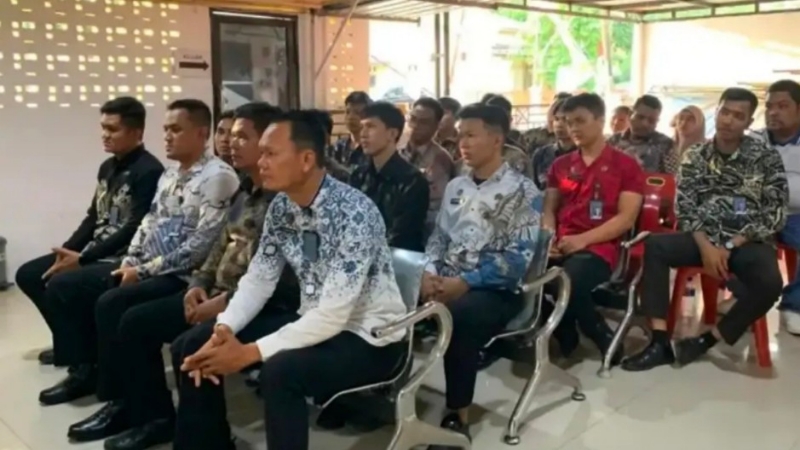
After inspecting the food security program, Jalu continued his tour of the residential blocks. There, he spoke directly with inmates to learn about their circumstances while also reviewing the implementation of services and rehabilitation programs on the ground.
Direct engagement was an important part of the visit because the quality of correctional services is reflected not only in the condition of buildings and the availability of facilities. The way inmates are supervised and rehabilitation programs are implemented are also important indicators of how correctional duties are being carried out.By directly inspecting the residential blocks and speaking with inmates, Jalu was able to gain a firsthand impression of how services were being delivered at the facility.
Following the inspection of the residential blocks, the regional official visited the staff workspaces. There, he discussed the implementation of duties and responsibilities with prison management and employees, as well as various challenges they face in their daily work.In strengthening the duties and responsibilities of the entire workforce, Jalu once again highlighted the development potential of Class III Kotapinang Prison, including the possibility of an upgrade.
In his assessment, this prospect must be accompanied by infrastructure improvements. Strong infrastructure is an important foundation for the development of a correctional institution, particularly if an upgrade results in increased capacity requirements and higher service standards.
Jalu urged the management of Class III Kotapinang Prison to prepare its development plans carefully. Particular attention must be paid to land requirements, including the possibility of relocation and the provision of sufficient space for future expansion of the facilities.
Spatial and land-use planning is an important component of correctional facility development. Without careful planning, the construction of new facilities could create new problems and may fail to meet long-term requirements.Therefore, any upgrade must be accompanied by increased capacity for inmate supervision and rehabilitation. Development should not be limited to a change in status but should result in improvements to facilities, services, rehabilitation programs and the overall implementation of correctional duties.
In addition to infrastructure, facilities and land requirements, Jalu also urged all employees to openly raise difficulties encountered while carrying out their duties.He encouraged staff not to keep problems arising during their work to themselves. Every difficulty should be reported so that the relevant authorities can seek solutions as quickly as possible.
The message also underscored the importance of open communication in strengthening the organization. When problems are raised at an early stage, solutions can be developed collectively before the issues become larger obstacles.The visit by the Head of the North Sumatra Regional Office of Ditjenpas ultimately demonstrated that Class III Kotapinang Prison stands between opportunities and challenges. The possibility of an upgrade exists, while various rehabilitation and inmate-support programs continue to be implemented.
The food security program through catfish farming is one of the initiatives being continuously developed. Inmate care also remains a focus, as demonstrated by the direct inspection of the kitchen and residential blocks.All of these efforts, however, require a solid foundation. Class III Kotapinang Prison needs to improve its infrastructure, anticipate future land requirements at an early stage and develop careful long-term plans.
At the same time, every employee has an important role in ensuring the success of the development process. The willingness to openly communicate practical problems is an essential part of improving coordination and finding solutions to existing challenges.Under the leadership of Prison Director Haris Damanik, these challenges also represent an opportunity to bring Class III Kotapinang Prison to a higher level.
Ultimately, the development of a correctional institution is not limited to an administrative upgrade. Rather, it must contribute to improving the quality of services and strengthening the rehabilitation function for inmates.With adequate infrastructure, sufficient land, careful planning and open internal communication, Class III Kotapinang Prison has the foundation needed to continue developing and make better use of its potential.
The proposed upgrade should therefore not merely mean larger facilities or a change in institutional status, but should also ensure a higher quality of inmate care and rehabilitation. This is the major task now facing Class III Kotapinang Prison. (IDNC)REPORTER: Jhon Fitra Sagala | EDITOR: Fik Sagala