Tuesday, 24 November 2026
MEDAN | INDATANEWS.COM - The Deli Serdang Regency Government is continuing to improve the quality of public services, with a strong emphasis on sincere service, prompt responses and integrity among public officials. This commitment is particularly important in the aftermath of disasters, when communities need reliable access to government services, especially for obtaining civil registration documents and meeting other essential administrative needs.
Through the National Public Service Movement (GNPP) 24/7, the Deli Serdang Regency Government is working to ensure that residents can access government services easily and promptly, including those affected by disasters. One of its key priorities is to accelerate the issuance of civil registration documents so that affected residents can regain access to various public services as quickly as possible.
Alongside efforts to speed up administrative services for disaster-affected communities, the local government is also continuing to develop its Public Service Mall (Mal Pelayanan Publik, MPP) as an integrated service centre. The facility is intended to streamline bureaucratic procedures, make public services more accessible and reduce the need for residents to visit multiple government offices to complete administrative matters.
Deli Serdang Regent Asri Ludin Tambunan said that since beginning operations in late January 2026, the Deli Serdang MPP has brought together 29 service providers offering a total of 129 services across various sectors.
This achievement forms part of the local government's efforts to establish a more integrated public service system. By bringing different services together in one location, residents are expected to save time and effort when applying for documents or accessing services provided by the relevant government agencies.
Asri Ludin explained that the Deli Serdang Regency Government was not focusing solely on expanding the range of services. It was also continuing to introduce innovations and conduct regular evaluations to improve the quality of services at the MPP. The local government has also opened opportunities for residents to submit criticism, suggestions and feedback as a basis for further improvements.
In his view, public service standards must continue to evolve in line with the needs of the community. The operation of the MPP therefore needs to go hand in hand with improvements in staff capabilities, simpler administrative procedures and stronger coordination between institutions.
"This meeting provides an opportunity to strengthen coordination, share experiences and receive feedback to improve the quality and readiness of public services, including when responding to disasters," he said.
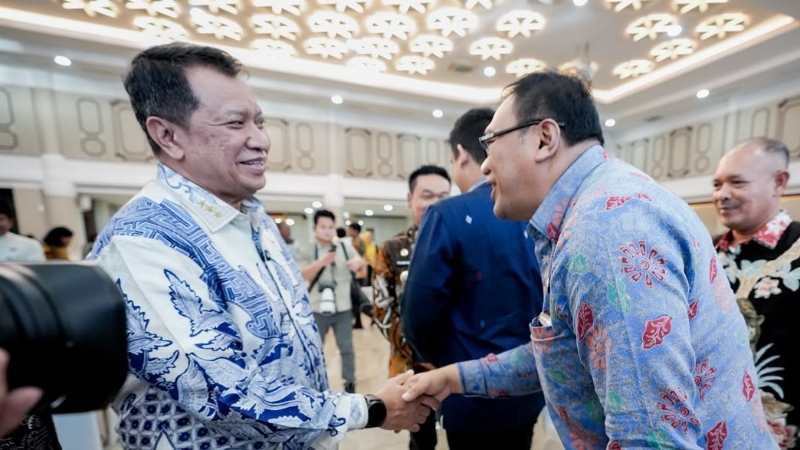
Asri Ludin made the remarks after attending a meeting with Deputy Minister for Administrative and Bureaucratic Reform (PANRB) Purwadi Arianto, a retired National Police Commissioner General. The event, entitled Optimising the Role of Public Service Malls in Restoring Public Services after Disasters, took place at the Raja Inal Hall at the North Sumatra Governor's Office on Thursday, 12 November 2026.

During the meeting, Purwadi Arianto stressed that restoring public services must form an essential part of post-disaster recovery efforts. Disasters, he explained, do not merely damage physical infrastructure and the environment. They also disrupt people's daily activities and restrict their access to government services.
The government must therefore ensure that essential services remain available. During emergencies and the recovery period, communities need public officials who can provide solutions quickly, appropriately and without unnecessary bureaucratic obstacles.
"When a disaster occurs, people need the government's presence even more. Restoring public services must be an important part of post-disaster recovery efforts. It is not enough simply to restore buildings and physical facilities; we must also ensure that the services most needed by the public can return to normal as quickly as possible," Purwadi said.
He explained that the government must place the needs of the public at the centre of every public service policy. Officials should not simply process administrative procedures; they must also understand the difficulties faced by residents, particularly those who have lost their documents, are living in evacuation centres or have limited access to government offices because of a disaster.
Purwadi also reminded officials that the spirit of GNPP 24/7 must become part of their everyday working culture. Sincere service, prompt responses and integrity must be reflected in every interaction with the public rather than remaining mere slogans at government events.
"The government must not be rigid. It is not the public who should have to adapt to the way the government works; rather, the government must adapt its services to the needs of the people. This includes providing outreach services to residents in isolated areas or evacuation centres," he added.
This outreach approach is considered particularly important for reaching communities that face difficulties accessing government offices. Through this system, officials can visit affected locations, remote areas and evacuation centres directly to help residents with administrative requirements and other public services.

Purwadi further emphasised that an MPP should not merely serve as a shared location for various government agencies and service providers. It must function as a genuinely integrated service centre that makes public services more accessible to the community.
In his view, the success of an MPP cannot be measured solely by the number of government agencies or service providers operating there. More importantly, its performance should be assessed by how effectively it speeds up the completion of residents' administrative matters, simplifies procedures and reduces the need for people to travel between different government offices.
He also announced plans to visit Deli Serdang to assess the condition and operation of its MPP in person.
"Tomorrow, I will visit Deli Serdang to see the condition of its MPP. Deli Serdang is among three new regencies in North Sumatra that already have an MPP. I hope other regions that do not yet have one will soon follow this example," he said.
The visit is expected to provide an overview of the development of integrated public services at regional level, while also serving as a basis for further evaluation and improvements. Integrated service centres are considered an important way of strengthening local governments' ability to meet community needs, both under normal circumstances and during emergencies.
Meanwhile, North Sumatra Governor Bobby Nasution said that 11 of the province's 33 regencies and municipalities currently have an MPP, including Deli Serdang Regency.
Bobby urged regency and municipal governments that already operate MPP facilities to continue expanding the range of services available. Any expansion, he said, should take account of the actual needs of residents so that these centres do not function merely as administrative facilities but provide tangible benefits in people's everyday lives.
Expanding the range of services must also go hand in hand with improvements in service quality, staff readiness and the use of technology. This would allow residents to access government services more conveniently without having to navigate lengthy bureaucratic procedures.
The call also serves as an encouragement to regions that have yet to establish an MPP to begin preparing for the development of integrated service centres. A more even distribution of public service facilities across all regencies and municipalities is expected to help reduce inequalities in access between urban communities and residents living further away from administrative centres.
Strengthening MPP facilities and accelerating the issuance of civil registration documents are part of broader efforts to build a more responsive public service system. In the aftermath of disasters, the speed at which the government restores access to essential services can have a significant impact on how quickly communities resume their daily activities and settle their administrative requirements.
Through GNPP 24/7, central and regional governments are expected to develop a more adaptable service culture that puts the interests of the public first and ensures that residents continue to receive government services regardless of geographical barriers or emergency circumstances. (IDNC)
REPORTER: Edi Saputra | EDITOR: Fik Sagala